— What Drives Winning (@WDWconvo) December 14, 2017
Monday, December 18, 2017

Monday, December 11, 2017
Shot/Goal Analysis
Below is a Shot Percentage & Goal Analysis from 11 of our games this season.
For Forwards/Defense- This chart shows is the importance of protecting high scoring areas. 71.4% of GA in the above games came from shots/rebounds below the hashmarks. Furthermore, only 52.1% of shots came from this area. As you can see, our goalies are proficient at stopping the “Easy” shots from the low scoring/conversion areas.
Save % Below the Hashmarks - 86.6%
Save % Above the Hashmarks - 94.2%
HUGE Difference
For Goalies - This shows the importance of controlling your rebounds and talking to your defenseman. While the chart doesn’t illustrate the exact scenario, what it does show is that opponents are getting a lot of PRIME scoring opportunities and converting. We need to work on being more vocal with our defenseman and calling out “back door,” “slot,” etc. so they can come in and support us.

Tracking
Watch this goal here for the Coyotes and spot the mistake.
I love Wood's hustle on this play but once the puck carrier has reached the attacking blue line Wood HAS to switch to cover the pass. Instead, he continues after the puck carrier and the defensman is left in an awkward spot.
Remember, If you are the backchecker, you go after the puck carrier until you get to your defending blue line. At that point you switch to covering the pass.
D Zone Body Positioning - Jason Bourne (The Athletic)
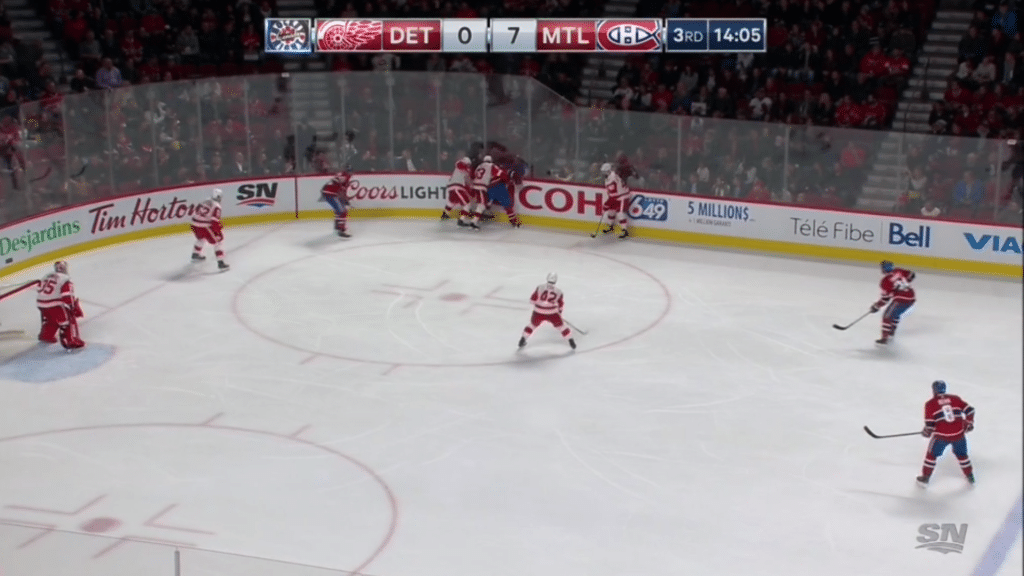
But this is another thing that Babcock, and I assume Blashill, talk about with regularity. Watch how their forwards play in the D-zone on any given night. When there's a battle in the weak side corner, all five guys are packed in pretty tight around that scrum. They want to give the opposing forwards no room to make a play and spread the defence out. They want to choke the play like a snake, smother it, take the puck back, and go play in the other end. They want there to be nowhere for their opponents to go. The biggest issue here?
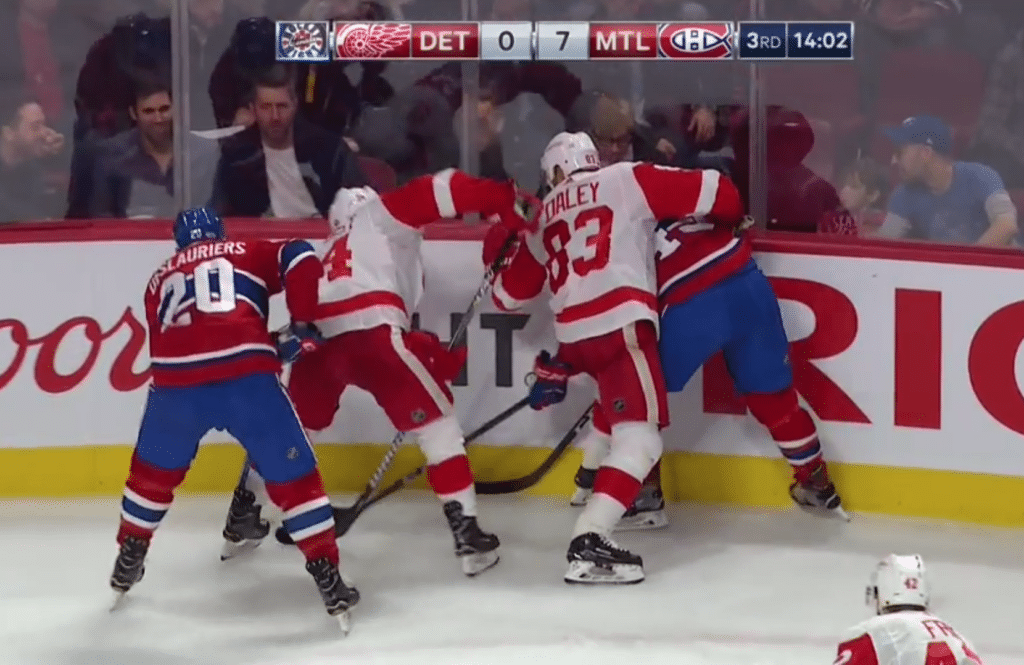
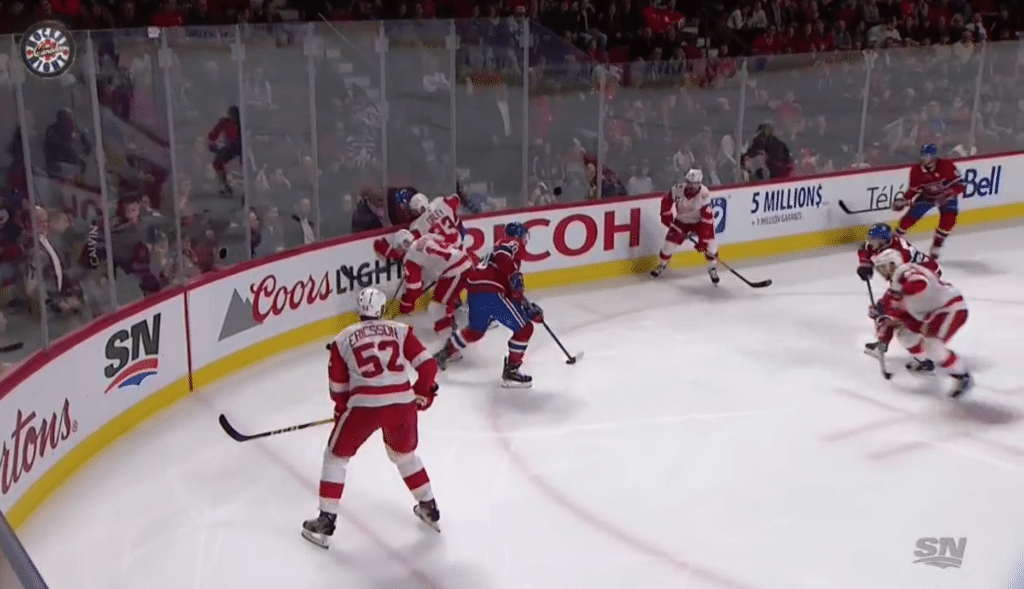
It's body position. Gustav Nyqvist is on the wrong side of his guy in the battle. Part of choking the play is being on the defensive side of your guy, and pushing that other guy up against the glass or into the mess of bodies so again, he has nowhere to go. He's smothered. Because when you're not on the right side of your guy, and the puck pops through your feet…
Friday, December 8, 2017
From the Athletic - Bourne: How NHL teams try to create at 5-on-5 in the offensive zone
If you’re a regular reader of my Systems Analyst posts, you’ve likely noticed a theme: I very rarely credit the offensive team for the goal. Hell, I rarely even mention them. That’s for a few reasons, and it's not because I don’t fully support goal-scoring.
Those reasons:
- Comparably speaking, there’s far less structure on the offensive side of the puck. Even the structure almost all teams are comfortable with – two D back, two forwards on the puck, with one forward higher in the zone – is largely in place for defensive purposes. If you turn the puck over, this still leaves you in fine shape.
- It’s less controllable, from a coaching standpoint. So much of offence is just trying to create chaos in hopes of there being a breakdown. Those come depending on the other team’s differing talent, their defensive structure and diligence, etc. Offensive players could do the same thing 10 times against 10 teams and get 10 different results. But if you’re playing well defensively, you expect the same outcome – no goal against, get the puck back, get out of the zone.
- Also, it’s often hard to know what an offensive player is trying to do, or what they saw. And from an analysis standpoint, you’d like to guess as little as possible. So on the defensive side, I feel a lot more comfortable saying, “that was that player's guy.”
In a nutshell, good defence should generally kill good offence. But since I rarely get into the other side of the puck, I thought it’d be good to go over some of the strategies teams use to create goals.
As I said before, the goal is chaos, but that doesn’t mean just flying around randomly and flinging the puck every which way. What teams want to do is summed up in an important phrase: they want to “change the shape” of the defence. When we’re talking defence and we say “structure,” that’s what I mean by shape.
There are a few ways to do that.
One that we see far too much for my liking, is going low-to-high with a pass, with the passer and other forwards generally heading towards the net for a likely shot attempt. That forces the D to pick up guys (“who has who?”) as they head back to the net. I say “far too much,” in that I don’t love the idea of a low percentage shot that is likely going to end up as a 50/50 puck battle after. Why go to a 50/50 chance of having it when you currently have 100 percent possession?
When players do go low-to-high though – and some times you have to — one thing is crucial. They have to do it as early as possible, ideally from below the goal line. So many young players skate the puck up the wall, then make the pass. Now they’ve brought their check up to the point while also giving their D-man less time to make a play. And not all D-men are the most, ahem, offensively efficient, we’ll say. (Few things are as frustrating as making a pass up to your D-man, who then proceeds to throw it into shinpads and kill the offensive zone possession.)
I’d like to see players use another strategy more: moving the puck east-to-west, particularly behind the net.
If you think about the general defensive structure, teams like to keep a D-man and a center in the corner, with a D-man in front of the net.
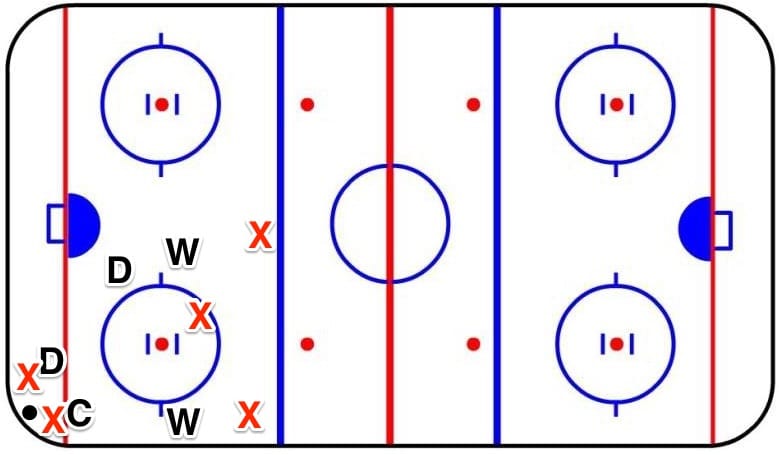
If that puck changes sides, the D in front of the net is generally going to be the guy to go chase it. Often, the puck changes sides with both low offensive players staying low. Every scenario is different, but that likely means the other D will now have to switch to net-front and hand off his check to the other D. It means the wingers will have to switch sides and find their proper positioning again. In all, it makes five players make decisions. It’s a hard game and things develop quickly – make players think enough, and you will find a chink in their armour.
The problem here, is teams know opponents want to change sides, so they diligently defend the back of their net, trying to keep things in coverage as simple as possible. As the evolution of offence goes, one thing you’re seeing is teams going low-to-high — which defences are more permissive of — then having that D-man just fire it into the other open corner (the lane will almost always be there, as forwards fill the shooting lane) with their forwards having immediately headed there after they passed the puck up.
There’s always going to be one or two forwards around the puck in plain sight. But along the lines of making the defence make decisions, you’re also seeing more forwards send their F3 really high in the zone. The best is when that F3 is active, as the D can lose track of them while trying to decide whether to chase him out or not. D-men don’t like operating way up there, far away from the net, and forwards love space. So D have to decide: If that’s my guy, how far out do I follow him? It's kind of a win either way for the low forwards. The D-men either leaves and creates more space to operate low, or they have an open teammate high who can dive down to help on any potential chances.
Things have evolved from the days of trying to cycle the puck mindlessly for a shift, coming to the bench, and high fiving your linemates for creating nothing. “Really wore ‘em down fellas! We never score, but boy, are they tired!” To combat the ol’ “do nothing on the outside” shifts, I find the best offensive tool a forward can use to be “threatening.”
Say a forward is coming up out of the corner towards his D-man. All the defence is trying to do is keep him to the outside – they expect their goalie to stop anything that comes from out there. But he’s coming up the wall, and everyone is man-on-man.
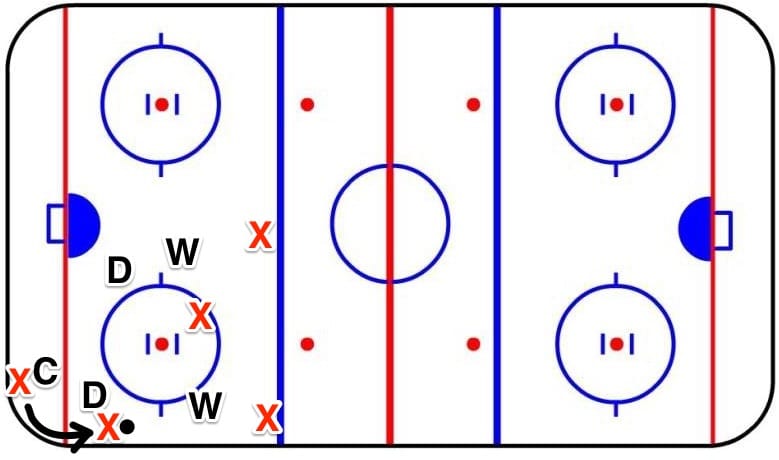
That’s fine! The D is pretty content with this. A lot of forwards just throw it back in the corner from here, or pass to the covered D. But when you threaten in through the seam below the winger…
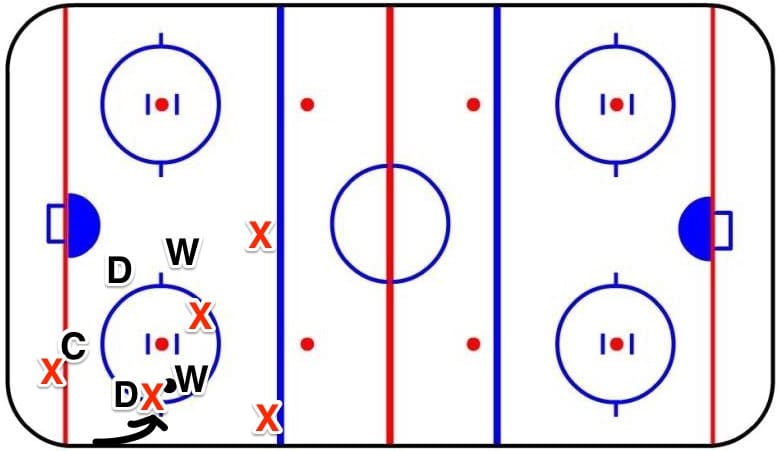
It triggers the defences “layers” to come to you. That strong-side winger is supposed to help in these situations. There are no free passes to the net. What that does, is pull people away from their current jobs, opening up space in other areas of the ice. I always reference basketball’s player tracking stat “gravity score” – how much do you pull other players towards you, leaving your teammates open? I know this doesn’t look like it created much room, but now that forward can give it to his D-man who has more space, so that player can take the puck down into the O-zone with room, and life just got easier. It also creates room to cut back and maintain possession if you’re well-defended. And if you aren’t, well dammit man, take it to the house.
That’s basically what offence is – testing, prodding, poking, feeling for a weak spot. This Matthew Barzal play from the other night is an awesome individual example. He’s testing, testing, testing until he sees his chance.
Thanks to this absolute clinic last night, Mat Barzal moved past Connor McDavid and is now 2nd in Offensive Zone Puck Possession / Game.— Mike Kelly (@MikeKellyNHL) December 6, 2017
1. P. Kane - 1:05
2. Barzal - 1:04
3. McDavid - 1:02 pic.twitter.com/Ssb7obCe99
Now, generally that doesn’t happen with one player – pretty hard when it’s 5-on-5, where that’s 3-on-3 – but the idea is the same.
Something you see more these days too, is teams using “short support.” You know on power plays today, players will pass the puck to the man in the middle on the inside of the opposing penalty kill, and that player will immediately kick it up to the D, or to another open player? That’s the idea – you always want at least one guy nice and close so the puck carrier has a relief valve if they suddenly find themselves under duress.
And from there, there’s always a staple: any time a team thinks they might have a prayer for a shot, they want bodies at the net causing ruckus. Coaches preach about players “throwing the puck blind,” which usually means making a prayer pass to the front of the net without even knowing if anyone is there. But what they won’t give you guff for, is throwing it into the blue paint from above the goal line, where you hope you have bodies, and you can create a puck battle in the most dangerous area of the ice.
Then there are things you can do as an individual that make “threatening” easier. Players today want to “put their ass on the hands” of defenders, or more appropriately “go through their hands.” Sometimes I think amateur players think that if they can’t get to the net untouched, it’s not happening. But you have to give yourself more credit than that. A moving body going through a defender's top hand renders that player pretty useless. And, if players can, they’ll also get their top-hand elbow in front of a defender and pull him back to get themselves that half-step that can make the difference. You have to use all the tools at your disposal, and that’s not a penalty.
And if you can’t go through an opponent, there’s huge value in deception, as I wrote about here. If you haven’t already, watch this video of Ryan Johansen selling a pass with his body that he directs somewhere totally different (the second view shows it best).
On the whole, creating offence is less about your team’s structure, and more about undoing your opponent’s. Players do adhere to some basic stuff – like if a teammate is skating at you with the puck, get moving. You see forwards do that with D-men sometimes, cueing a “roll” of sorts, like you see on the power play. Players are expected to screen goalies and tip pucks. Thy want to take the puck across the net and open the goalie up. Those sorts of simple things. But overall, there’s mostly freedom to be creative in the O-zone.
Getting anything accomplished at 5-on-5, even with solid possession in the O-zone, is probably the hardest thing to do in the game, outside playing goal. Teams are paying more attention to how to create, but there aren’t many simple answers. It’s mostly a lot of hard work and battling for time and space, then trying to change the shape of the D’s structure when you actually win some.
It might also be the best part of hockey — it’s so unpredictable, and so “take what you can get,” that coaches can’t really coach the hell out of it. And for fans and players alike, that’s a bit of a blessing. Structure be damned, playing on offence is just fun.
Tuesday, December 5, 2017
Goalies - Playing the Puck
In practice yesterday (12/4) we attempted to get the goalies involved in the breakout. While it wasn't the smoothest integration, it gave us a starting point.
Alex, Charles, Robert - view the video below for some good teaching points.
There are 3 Key things I see here:
1. Scanning the Ice - This is crucial so that you can assess the pressure as well as begin to look for your outlets
2. Poise - These goalies aren't panicking with the puck on their stick, they are poised and ready to make a smart pass or leave behind the net.
3. Recovery - Even when a goalie misses the puck, they are making a fast & smart recovery back into the net.
As we continue to progress into the season, we will want to start having you be more comfortable playing the puck and leading the breakout. As you progress to higher-level hockey this is crucial to your success.
Friday, December 1, 2017
Fore-checking and Hustle Creating Offense (Taken from Evan Sporer article - The Athletic)
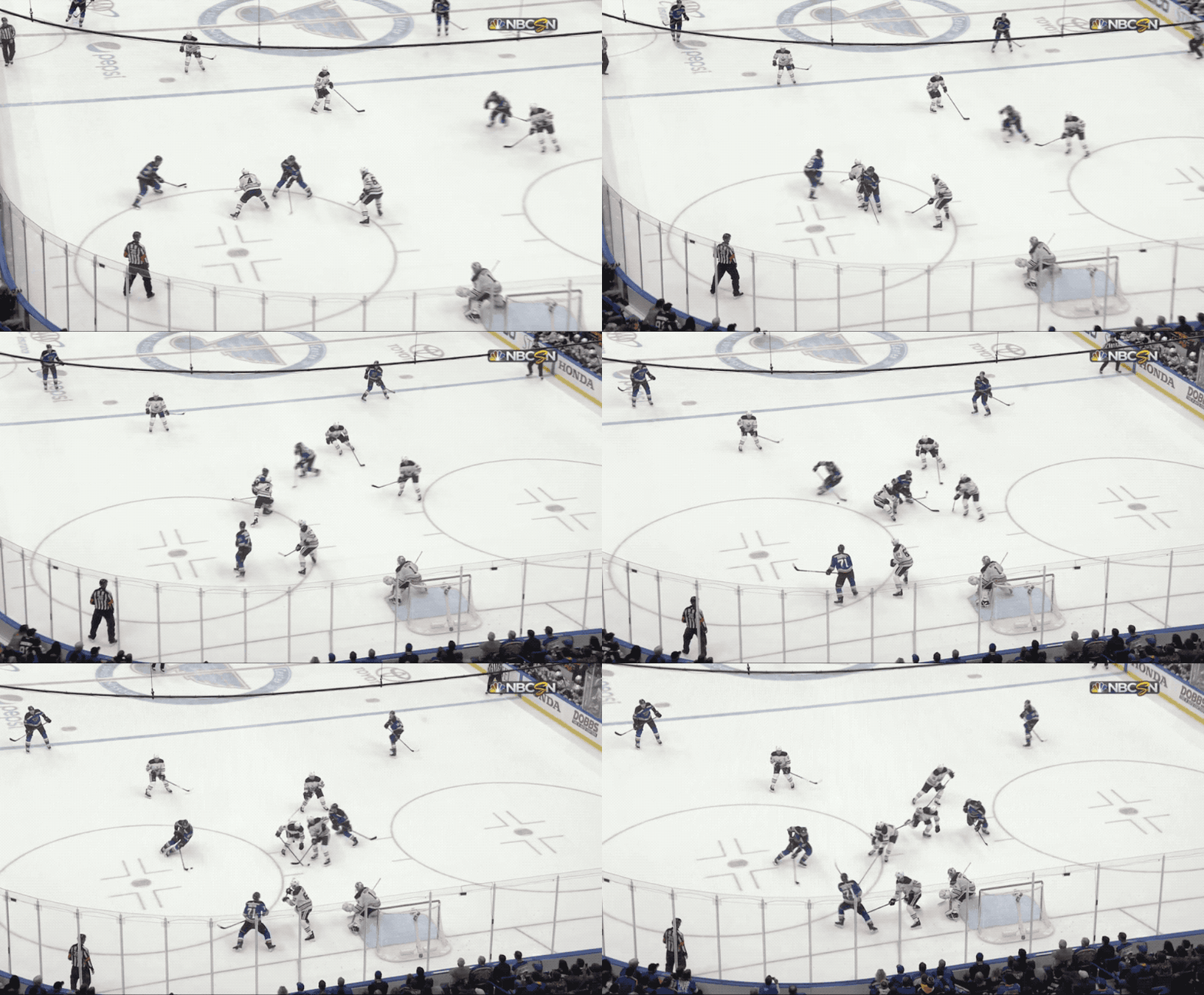
This entire sequence starts with Stastny making a hustle play that doesn't show up on the scoresheet. Stastny starts this chain of events with a high-effort forecheck that greases the wheels. When Edmonton wins possession back, Zack Kassian has it along the wall. But with the puck on his backhand, Stastny quickly closes the gap, forces Kassian to flip the puck toward center ice and the uncontrolled exit gives the puck right back to the Blues. Again, this is an example of creating favorable rushes with effective fore-checking.
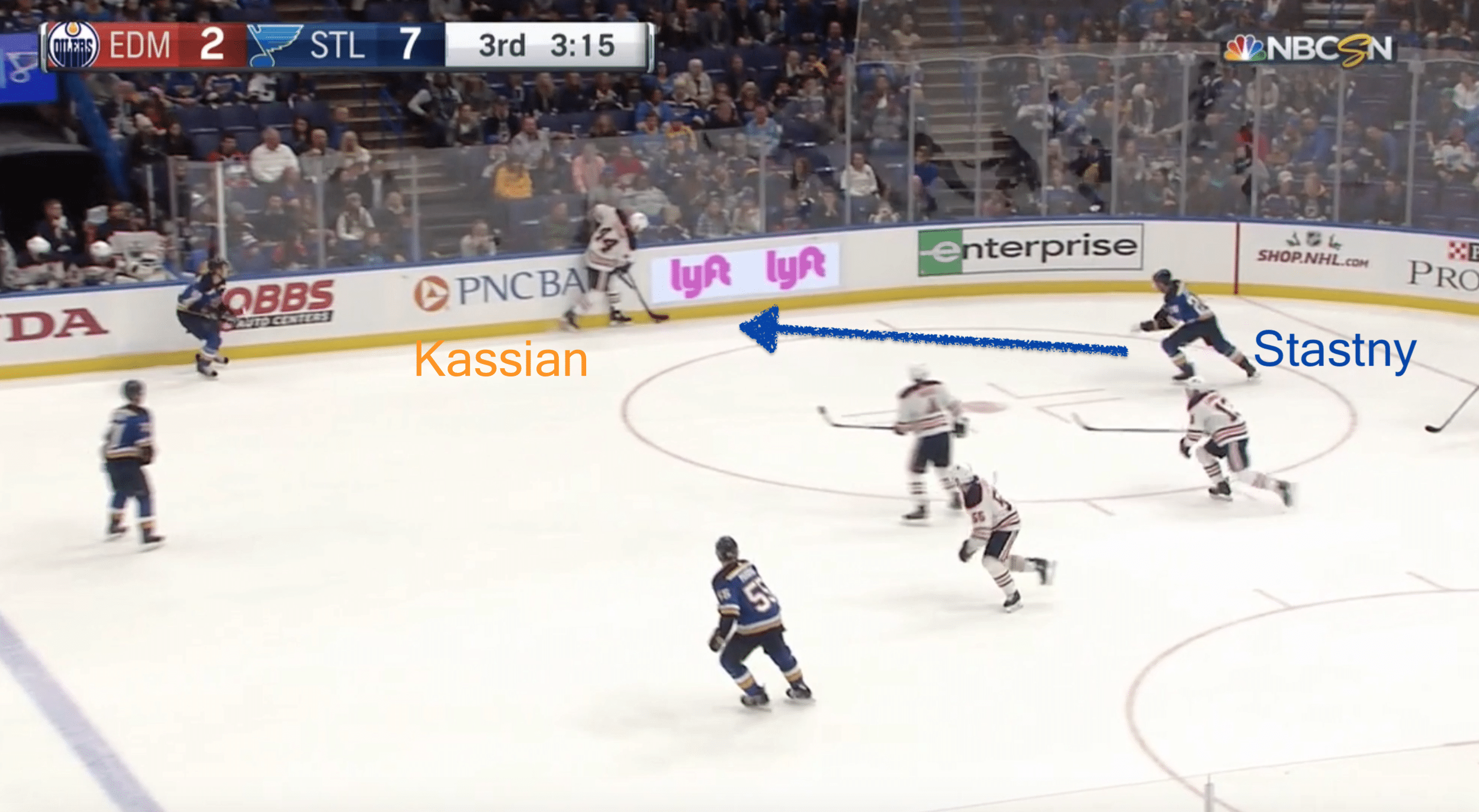
When Colton Parayko pokes the puck toward the center circle, Stastny is tagging up in the neutral zone and ends up in the play. He turns to re-enter the zone, with St. Louis coming across 3-on-3. Kris Russell, closest to Stastny, concedes a pretty big gap, one Stastny will soon exploit. (see above photo)
This is where Stastny makes the play happen. With Russell still playing that reaching-defense, Stastny is going to leave the puck and make a hard cut across the zone. But what's creative about this play is instead of scissoring with Vladimir Sobotka, who's directly to Stastny's left, Alexander Steen is going to come all the way down and over from the right side of the frame. The movement creates a natural pick, leaving Stastny all alone on the far side. (See Below)
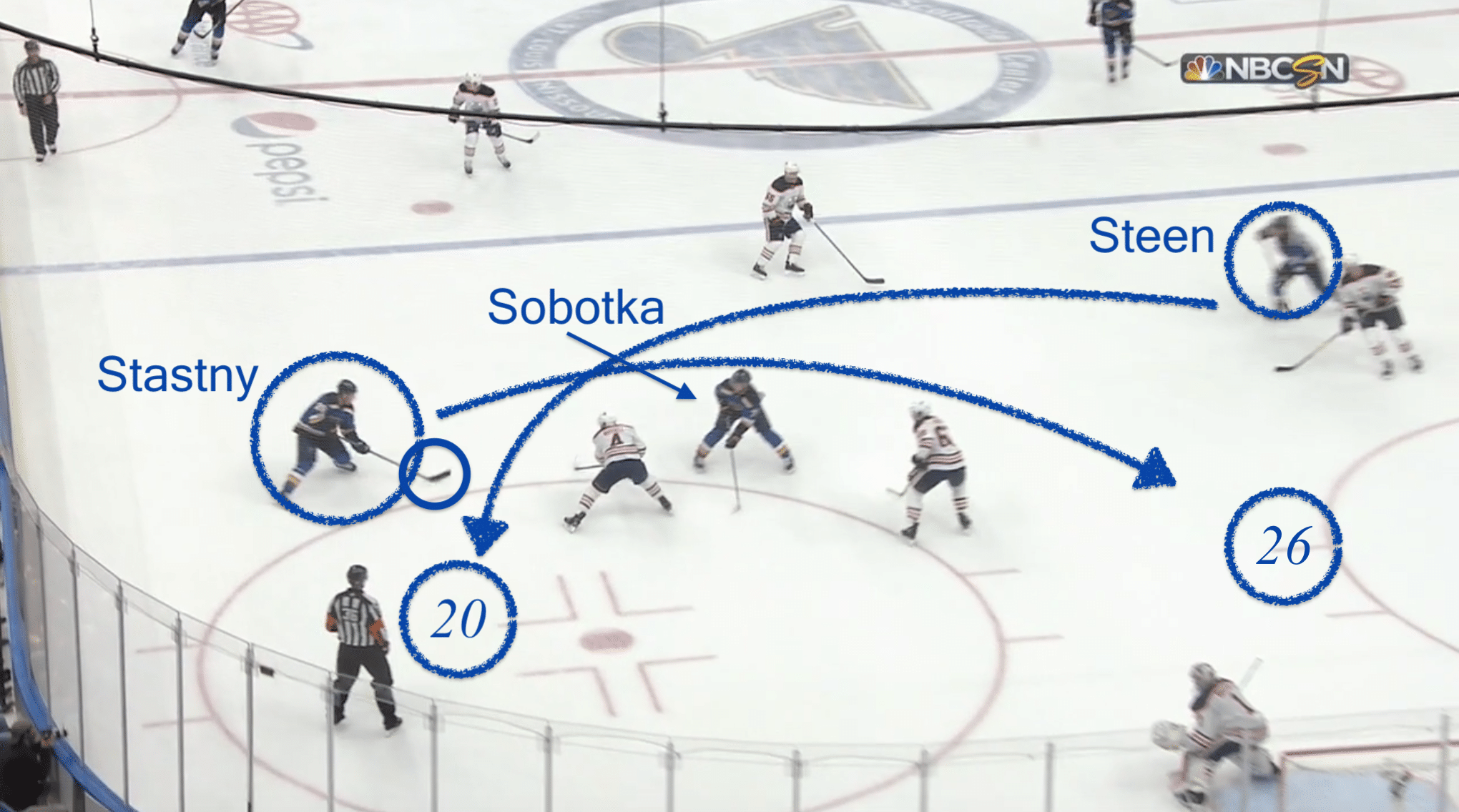
Instead of taking a shot from the outside, rimming this puck down the boards or trying to squeeze in a pass that wasn't there, Stastny forces the issue and gets himself into a dangerous scoring area.
Bonus Goal Breakdown: On this primary assist, Stastny again uses his speed to change the spacing in the zone, creating a scoring opportunity for his teammate.
The Blues win the puck back and get out to center ice, and Stastny hops over the boards to begin his shift.
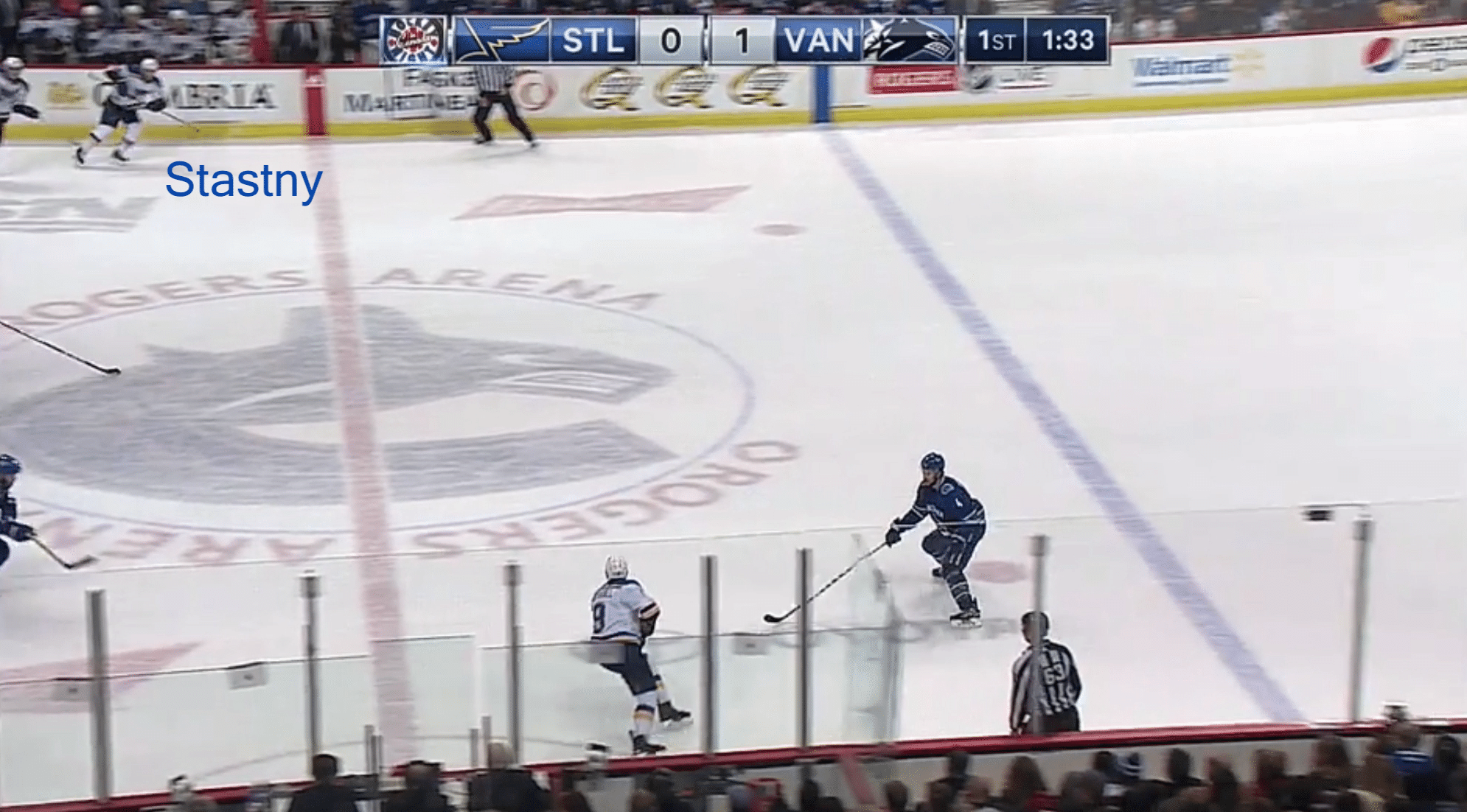
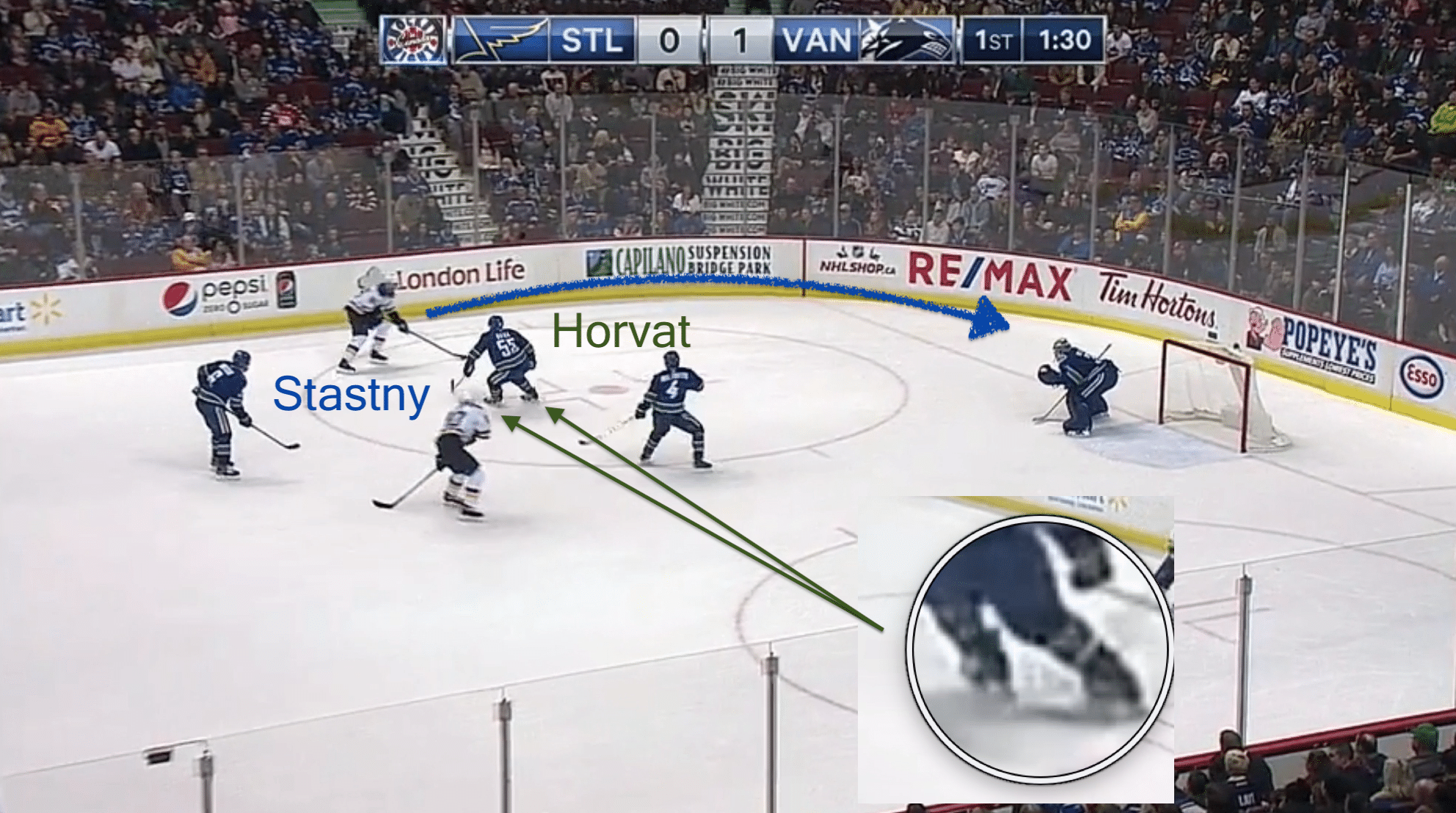
While Bo Horvat comes across and catches up with Stastny, Horvat is not in a good defensive stance. Because he came from the other side of the ice, Horvat's skates are sideways. He's not in a position on his edges to keep up with Stastny, who identifies this and takes Horvat wide, carrying the puck below the goal line.
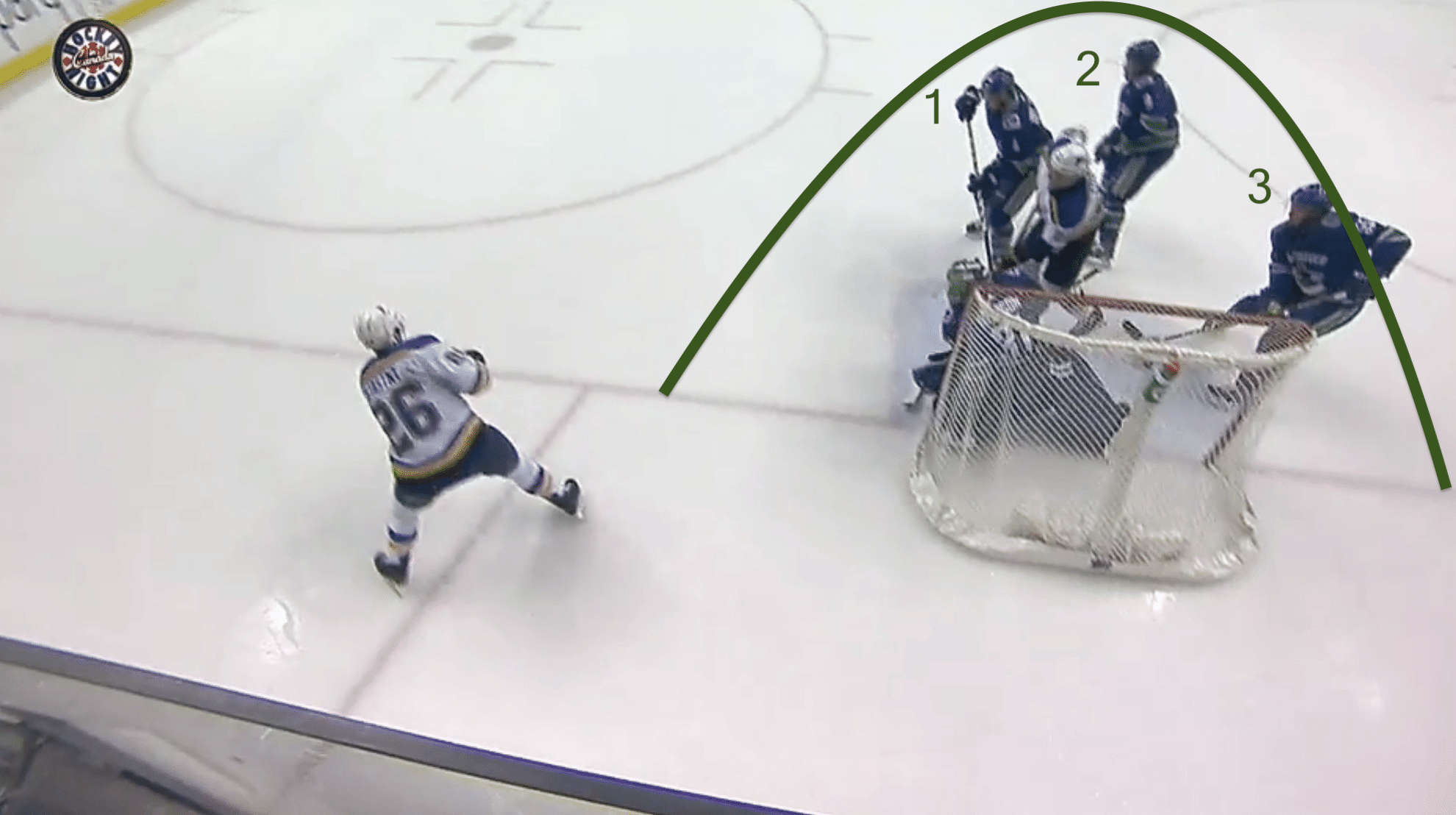
And this decision to circle below the goal has a byproduct. When Stastny cuts out at the other post, three Canucks are bunched in and around the crease (also in part because Steen crashed the net, a good play by him). Stastny has his head up the entire way and identifies Parayko coming down from the point, laying a perfect, flat pass for the defenseman to skate into.
Subscribe to:
Posts (Atom)