— What Drives Winning (@WDWconvo) December 14, 2017
Monday, December 18, 2017

Monday, December 11, 2017
Shot/Goal Analysis
Below is a Shot Percentage & Goal Analysis from 11 of our games this season.
For Forwards/Defense- This chart shows is the importance of protecting high scoring areas. 71.4% of GA in the above games came from shots/rebounds below the hashmarks. Furthermore, only 52.1% of shots came from this area. As you can see, our goalies are proficient at stopping the “Easy” shots from the low scoring/conversion areas.
Save % Below the Hashmarks - 86.6%
Save % Above the Hashmarks - 94.2%
HUGE Difference
For Goalies - This shows the importance of controlling your rebounds and talking to your defenseman. While the chart doesn’t illustrate the exact scenario, what it does show is that opponents are getting a lot of PRIME scoring opportunities and converting. We need to work on being more vocal with our defenseman and calling out “back door,” “slot,” etc. so they can come in and support us.

Tracking
Watch this goal here for the Coyotes and spot the mistake.
I love Wood's hustle on this play but once the puck carrier has reached the attacking blue line Wood HAS to switch to cover the pass. Instead, he continues after the puck carrier and the defensman is left in an awkward spot.
Remember, If you are the backchecker, you go after the puck carrier until you get to your defending blue line. At that point you switch to covering the pass.
D Zone Body Positioning - Jason Bourne (The Athletic)
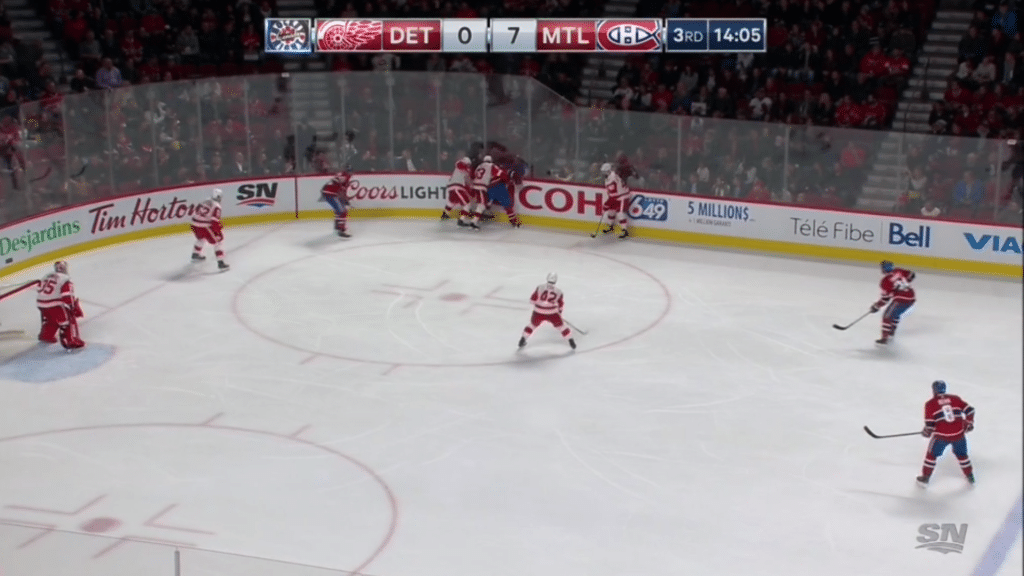
But this is another thing that Babcock, and I assume Blashill, talk about with regularity. Watch how their forwards play in the D-zone on any given night. When there's a battle in the weak side corner, all five guys are packed in pretty tight around that scrum. They want to give the opposing forwards no room to make a play and spread the defence out. They want to choke the play like a snake, smother it, take the puck back, and go play in the other end. They want there to be nowhere for their opponents to go. The biggest issue here?
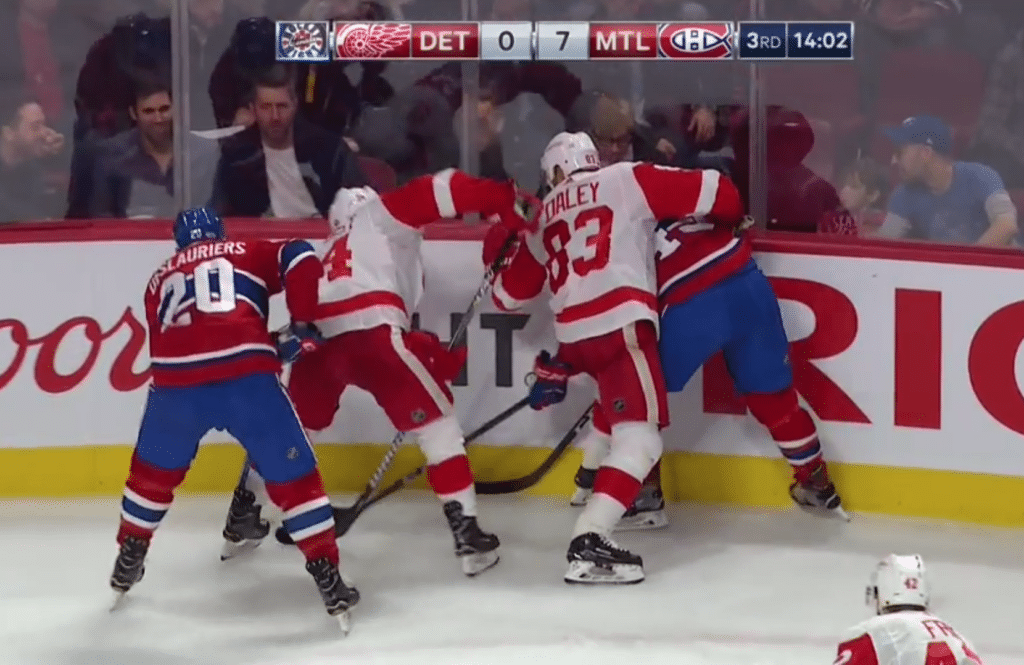
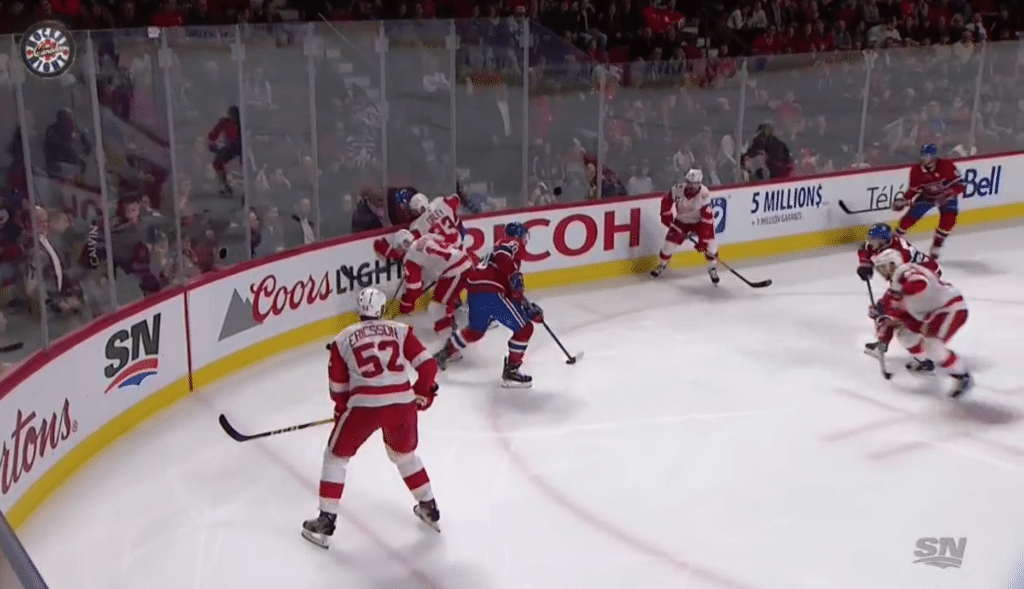
It's body position. Gustav Nyqvist is on the wrong side of his guy in the battle. Part of choking the play is being on the defensive side of your guy, and pushing that other guy up against the glass or into the mess of bodies so again, he has nowhere to go. He's smothered. Because when you're not on the right side of your guy, and the puck pops through your feet…
Friday, December 8, 2017
From the Athletic - Bourne: How NHL teams try to create at 5-on-5 in the offensive zone
If you’re a regular reader of my Systems Analyst posts, you’ve likely noticed a theme: I very rarely credit the offensive team for the goal. Hell, I rarely even mention them. That’s for a few reasons, and it's not because I don’t fully support goal-scoring.
Those reasons:
- Comparably speaking, there’s far less structure on the offensive side of the puck. Even the structure almost all teams are comfortable with – two D back, two forwards on the puck, with one forward higher in the zone – is largely in place for defensive purposes. If you turn the puck over, this still leaves you in fine shape.
- It’s less controllable, from a coaching standpoint. So much of offence is just trying to create chaos in hopes of there being a breakdown. Those come depending on the other team’s differing talent, their defensive structure and diligence, etc. Offensive players could do the same thing 10 times against 10 teams and get 10 different results. But if you’re playing well defensively, you expect the same outcome – no goal against, get the puck back, get out of the zone.
- Also, it’s often hard to know what an offensive player is trying to do, or what they saw. And from an analysis standpoint, you’d like to guess as little as possible. So on the defensive side, I feel a lot more comfortable saying, “that was that player's guy.”
In a nutshell, good defence should generally kill good offence. But since I rarely get into the other side of the puck, I thought it’d be good to go over some of the strategies teams use to create goals.
As I said before, the goal is chaos, but that doesn’t mean just flying around randomly and flinging the puck every which way. What teams want to do is summed up in an important phrase: they want to “change the shape” of the defence. When we’re talking defence and we say “structure,” that’s what I mean by shape.
There are a few ways to do that.
One that we see far too much for my liking, is going low-to-high with a pass, with the passer and other forwards generally heading towards the net for a likely shot attempt. That forces the D to pick up guys (“who has who?”) as they head back to the net. I say “far too much,” in that I don’t love the idea of a low percentage shot that is likely going to end up as a 50/50 puck battle after. Why go to a 50/50 chance of having it when you currently have 100 percent possession?
When players do go low-to-high though – and some times you have to — one thing is crucial. They have to do it as early as possible, ideally from below the goal line. So many young players skate the puck up the wall, then make the pass. Now they’ve brought their check up to the point while also giving their D-man less time to make a play. And not all D-men are the most, ahem, offensively efficient, we’ll say. (Few things are as frustrating as making a pass up to your D-man, who then proceeds to throw it into shinpads and kill the offensive zone possession.)
I’d like to see players use another strategy more: moving the puck east-to-west, particularly behind the net.
If you think about the general defensive structure, teams like to keep a D-man and a center in the corner, with a D-man in front of the net.
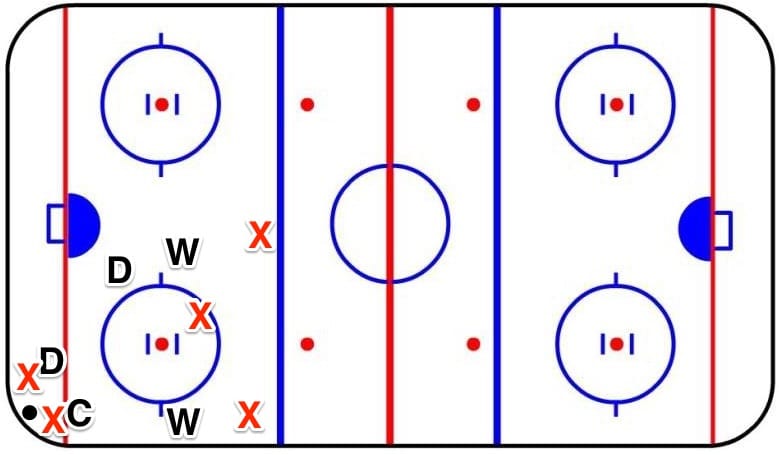
If that puck changes sides, the D in front of the net is generally going to be the guy to go chase it. Often, the puck changes sides with both low offensive players staying low. Every scenario is different, but that likely means the other D will now have to switch to net-front and hand off his check to the other D. It means the wingers will have to switch sides and find their proper positioning again. In all, it makes five players make decisions. It’s a hard game and things develop quickly – make players think enough, and you will find a chink in their armour.
The problem here, is teams know opponents want to change sides, so they diligently defend the back of their net, trying to keep things in coverage as simple as possible. As the evolution of offence goes, one thing you’re seeing is teams going low-to-high — which defences are more permissive of — then having that D-man just fire it into the other open corner (the lane will almost always be there, as forwards fill the shooting lane) with their forwards having immediately headed there after they passed the puck up.
There’s always going to be one or two forwards around the puck in plain sight. But along the lines of making the defence make decisions, you’re also seeing more forwards send their F3 really high in the zone. The best is when that F3 is active, as the D can lose track of them while trying to decide whether to chase him out or not. D-men don’t like operating way up there, far away from the net, and forwards love space. So D have to decide: If that’s my guy, how far out do I follow him? It's kind of a win either way for the low forwards. The D-men either leaves and creates more space to operate low, or they have an open teammate high who can dive down to help on any potential chances.
Things have evolved from the days of trying to cycle the puck mindlessly for a shift, coming to the bench, and high fiving your linemates for creating nothing. “Really wore ‘em down fellas! We never score, but boy, are they tired!” To combat the ol’ “do nothing on the outside” shifts, I find the best offensive tool a forward can use to be “threatening.”
Say a forward is coming up out of the corner towards his D-man. All the defence is trying to do is keep him to the outside – they expect their goalie to stop anything that comes from out there. But he’s coming up the wall, and everyone is man-on-man.
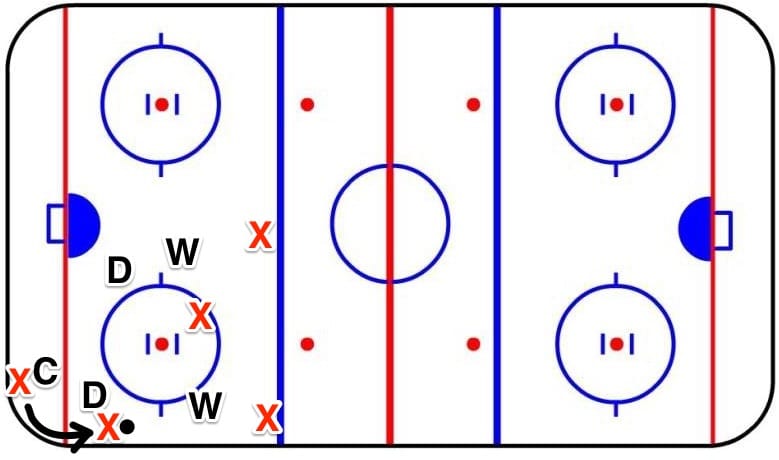
That’s fine! The D is pretty content with this. A lot of forwards just throw it back in the corner from here, or pass to the covered D. But when you threaten in through the seam below the winger…
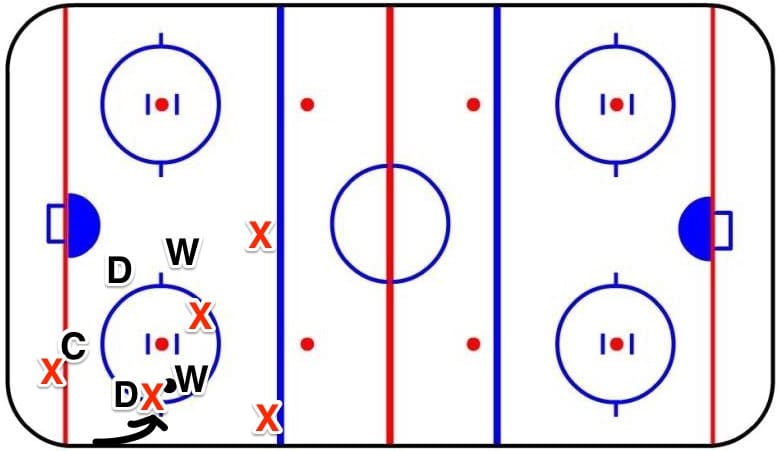
It triggers the defences “layers” to come to you. That strong-side winger is supposed to help in these situations. There are no free passes to the net. What that does, is pull people away from their current jobs, opening up space in other areas of the ice. I always reference basketball’s player tracking stat “gravity score” – how much do you pull other players towards you, leaving your teammates open? I know this doesn’t look like it created much room, but now that forward can give it to his D-man who has more space, so that player can take the puck down into the O-zone with room, and life just got easier. It also creates room to cut back and maintain possession if you’re well-defended. And if you aren’t, well dammit man, take it to the house.
That’s basically what offence is – testing, prodding, poking, feeling for a weak spot. This Matthew Barzal play from the other night is an awesome individual example. He’s testing, testing, testing until he sees his chance.
Thanks to this absolute clinic last night, Mat Barzal moved past Connor McDavid and is now 2nd in Offensive Zone Puck Possession / Game.— Mike Kelly (@MikeKellyNHL) December 6, 2017
1. P. Kane - 1:05
2. Barzal - 1:04
3. McDavid - 1:02 pic.twitter.com/Ssb7obCe99
Now, generally that doesn’t happen with one player – pretty hard when it’s 5-on-5, where that’s 3-on-3 – but the idea is the same.
Something you see more these days too, is teams using “short support.” You know on power plays today, players will pass the puck to the man in the middle on the inside of the opposing penalty kill, and that player will immediately kick it up to the D, or to another open player? That’s the idea – you always want at least one guy nice and close so the puck carrier has a relief valve if they suddenly find themselves under duress.
And from there, there’s always a staple: any time a team thinks they might have a prayer for a shot, they want bodies at the net causing ruckus. Coaches preach about players “throwing the puck blind,” which usually means making a prayer pass to the front of the net without even knowing if anyone is there. But what they won’t give you guff for, is throwing it into the blue paint from above the goal line, where you hope you have bodies, and you can create a puck battle in the most dangerous area of the ice.
Then there are things you can do as an individual that make “threatening” easier. Players today want to “put their ass on the hands” of defenders, or more appropriately “go through their hands.” Sometimes I think amateur players think that if they can’t get to the net untouched, it’s not happening. But you have to give yourself more credit than that. A moving body going through a defender's top hand renders that player pretty useless. And, if players can, they’ll also get their top-hand elbow in front of a defender and pull him back to get themselves that half-step that can make the difference. You have to use all the tools at your disposal, and that’s not a penalty.
And if you can’t go through an opponent, there’s huge value in deception, as I wrote about here. If you haven’t already, watch this video of Ryan Johansen selling a pass with his body that he directs somewhere totally different (the second view shows it best).
On the whole, creating offence is less about your team’s structure, and more about undoing your opponent’s. Players do adhere to some basic stuff – like if a teammate is skating at you with the puck, get moving. You see forwards do that with D-men sometimes, cueing a “roll” of sorts, like you see on the power play. Players are expected to screen goalies and tip pucks. Thy want to take the puck across the net and open the goalie up. Those sorts of simple things. But overall, there’s mostly freedom to be creative in the O-zone.
Getting anything accomplished at 5-on-5, even with solid possession in the O-zone, is probably the hardest thing to do in the game, outside playing goal. Teams are paying more attention to how to create, but there aren’t many simple answers. It’s mostly a lot of hard work and battling for time and space, then trying to change the shape of the D’s structure when you actually win some.
It might also be the best part of hockey — it’s so unpredictable, and so “take what you can get,” that coaches can’t really coach the hell out of it. And for fans and players alike, that’s a bit of a blessing. Structure be damned, playing on offence is just fun.
Tuesday, December 5, 2017
Goalies - Playing the Puck
In practice yesterday (12/4) we attempted to get the goalies involved in the breakout. While it wasn't the smoothest integration, it gave us a starting point.
Alex, Charles, Robert - view the video below for some good teaching points.
There are 3 Key things I see here:
1. Scanning the Ice - This is crucial so that you can assess the pressure as well as begin to look for your outlets
2. Poise - These goalies aren't panicking with the puck on their stick, they are poised and ready to make a smart pass or leave behind the net.
3. Recovery - Even when a goalie misses the puck, they are making a fast & smart recovery back into the net.
As we continue to progress into the season, we will want to start having you be more comfortable playing the puck and leading the breakout. As you progress to higher-level hockey this is crucial to your success.
Friday, December 1, 2017
Fore-checking and Hustle Creating Offense (Taken from Evan Sporer article - The Athletic)
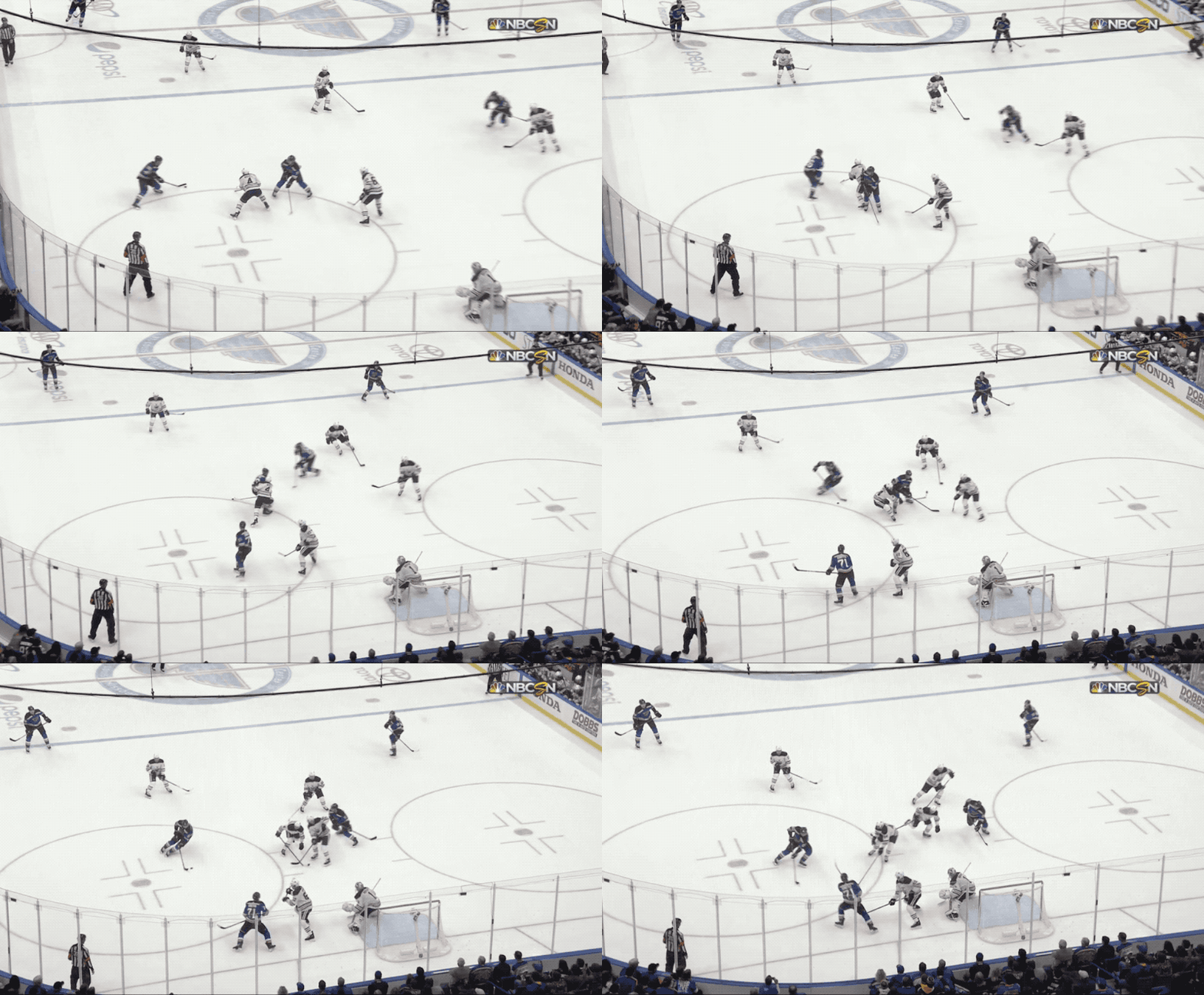
This entire sequence starts with Stastny making a hustle play that doesn't show up on the scoresheet. Stastny starts this chain of events with a high-effort forecheck that greases the wheels. When Edmonton wins possession back, Zack Kassian has it along the wall. But with the puck on his backhand, Stastny quickly closes the gap, forces Kassian to flip the puck toward center ice and the uncontrolled exit gives the puck right back to the Blues. Again, this is an example of creating favorable rushes with effective fore-checking.
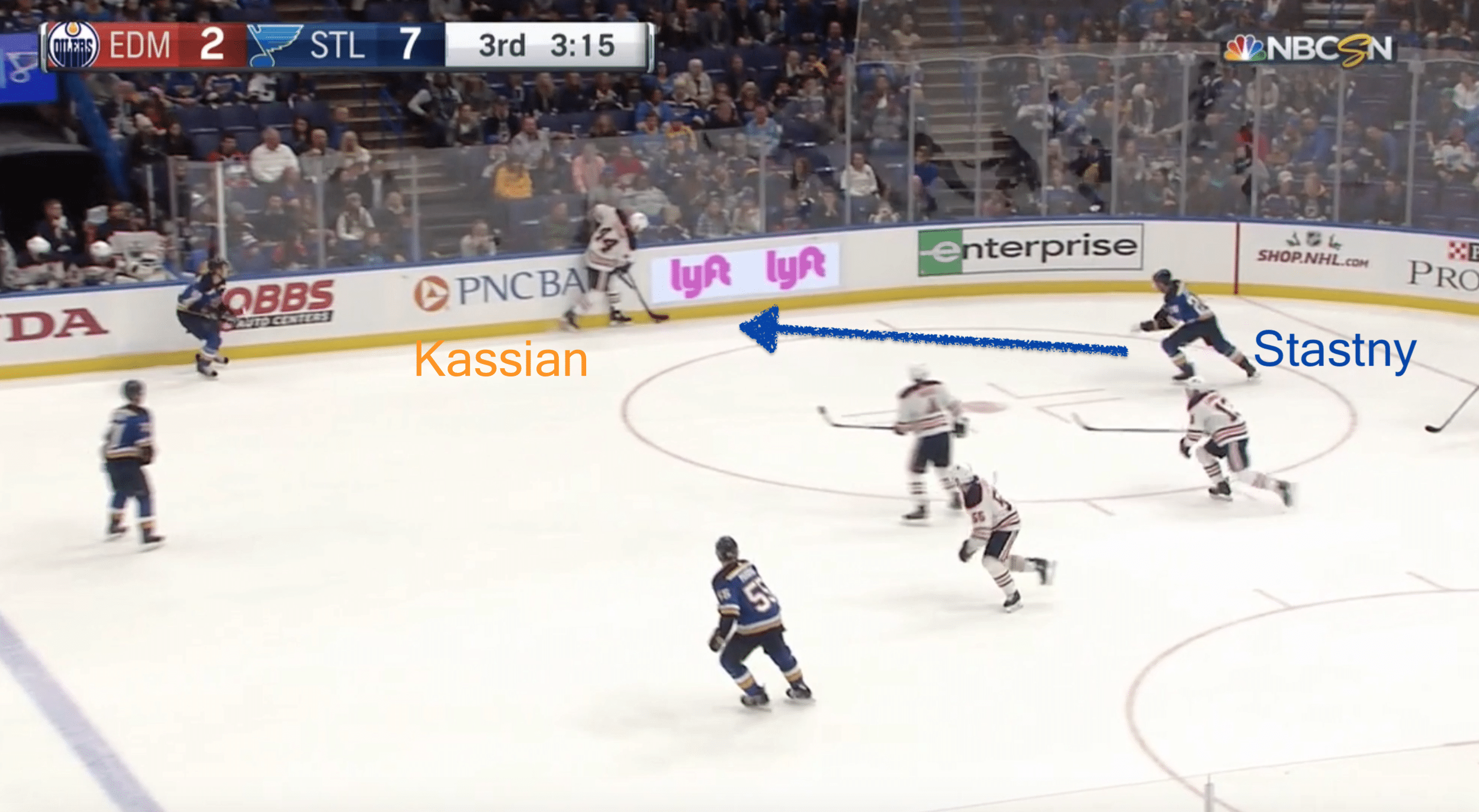
When Colton Parayko pokes the puck toward the center circle, Stastny is tagging up in the neutral zone and ends up in the play. He turns to re-enter the zone, with St. Louis coming across 3-on-3. Kris Russell, closest to Stastny, concedes a pretty big gap, one Stastny will soon exploit. (see above photo)
This is where Stastny makes the play happen. With Russell still playing that reaching-defense, Stastny is going to leave the puck and make a hard cut across the zone. But what's creative about this play is instead of scissoring with Vladimir Sobotka, who's directly to Stastny's left, Alexander Steen is going to come all the way down and over from the right side of the frame. The movement creates a natural pick, leaving Stastny all alone on the far side. (See Below)
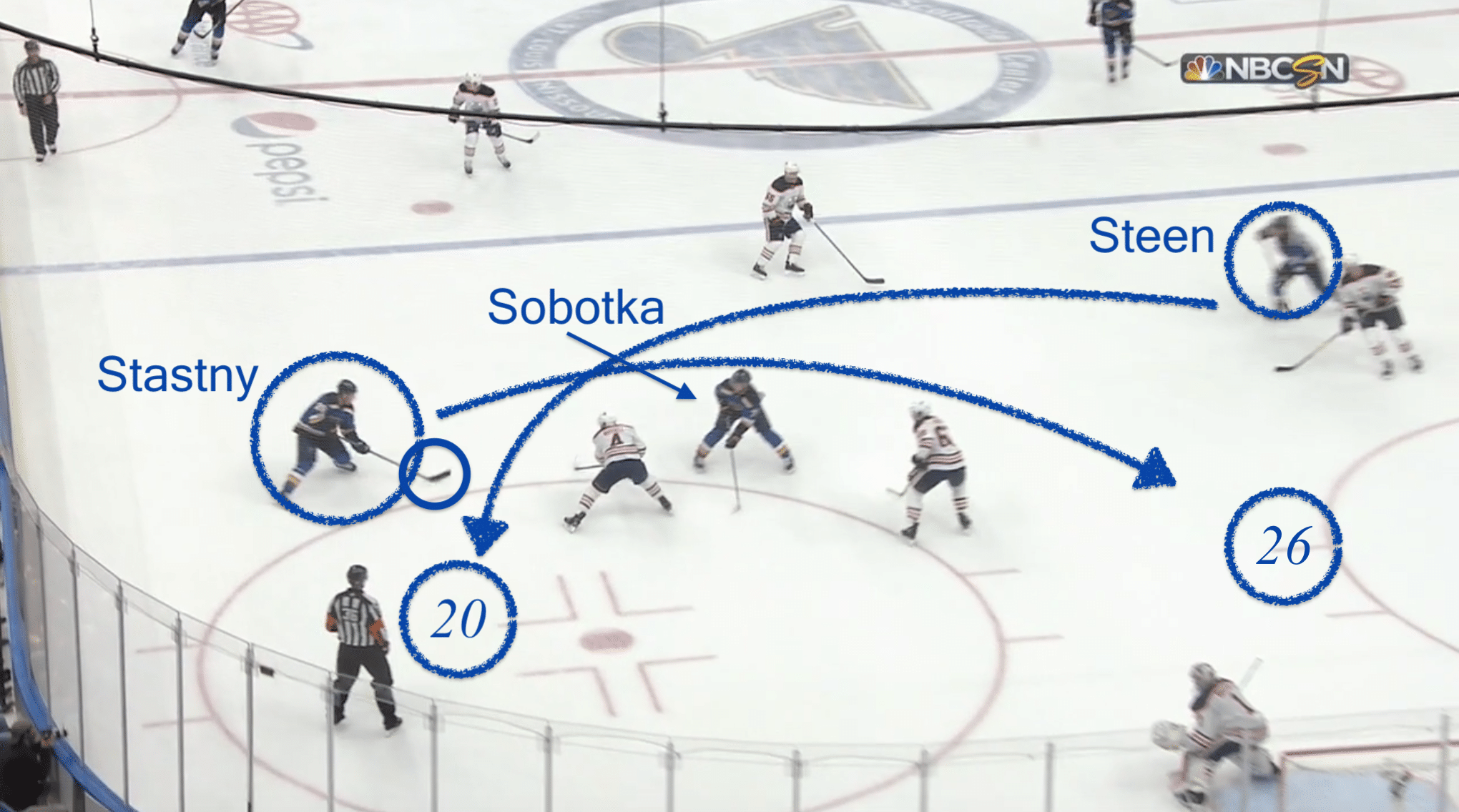
Instead of taking a shot from the outside, rimming this puck down the boards or trying to squeeze in a pass that wasn't there, Stastny forces the issue and gets himself into a dangerous scoring area.
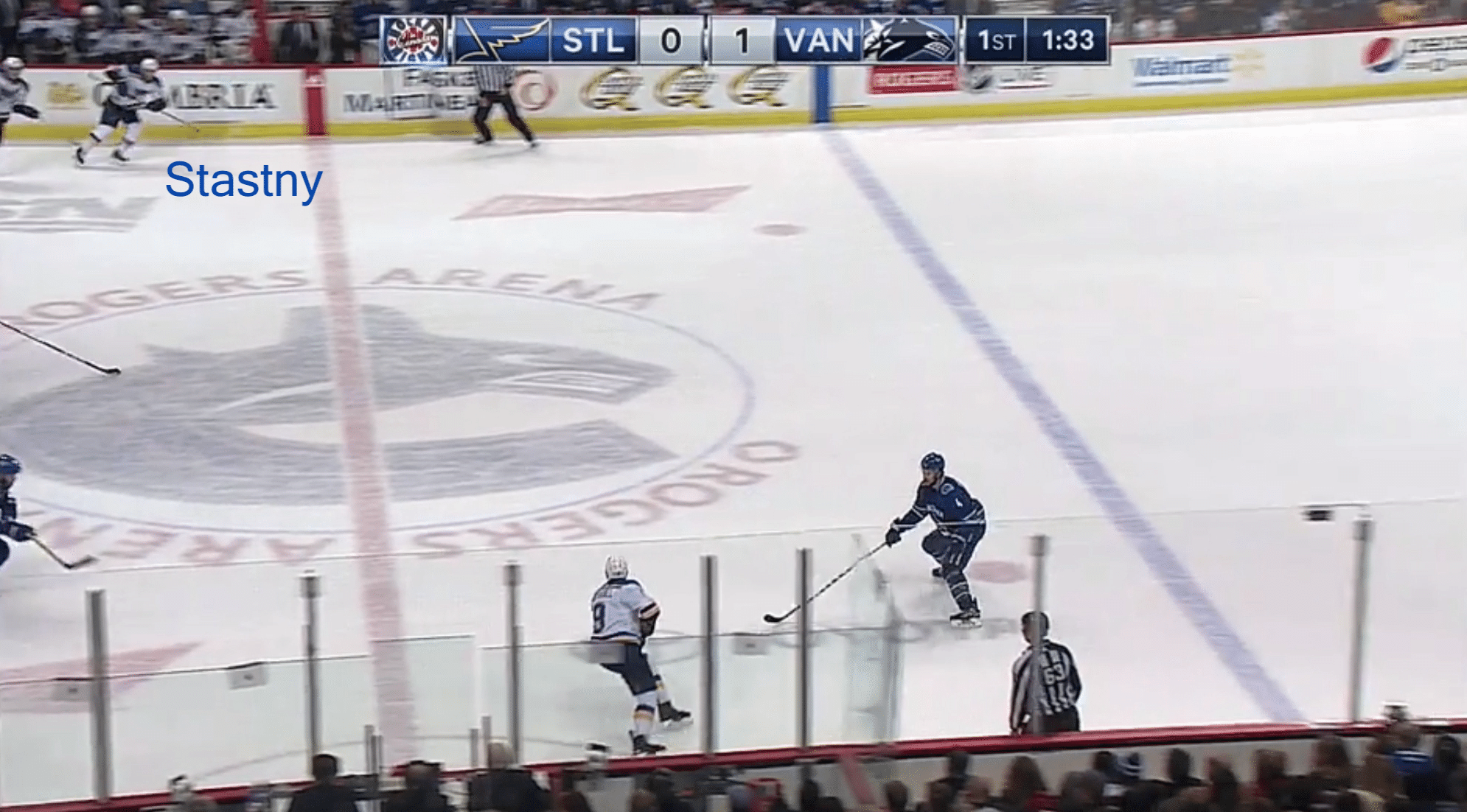
Bonus Goal Breakdown: On this primary assist, Stastny again uses his speed to change the spacing in the zone, creating a scoring opportunity for his teammate.
The Blues win the puck back and get out to center ice, and Stastny hops over the boards to begin his shift.
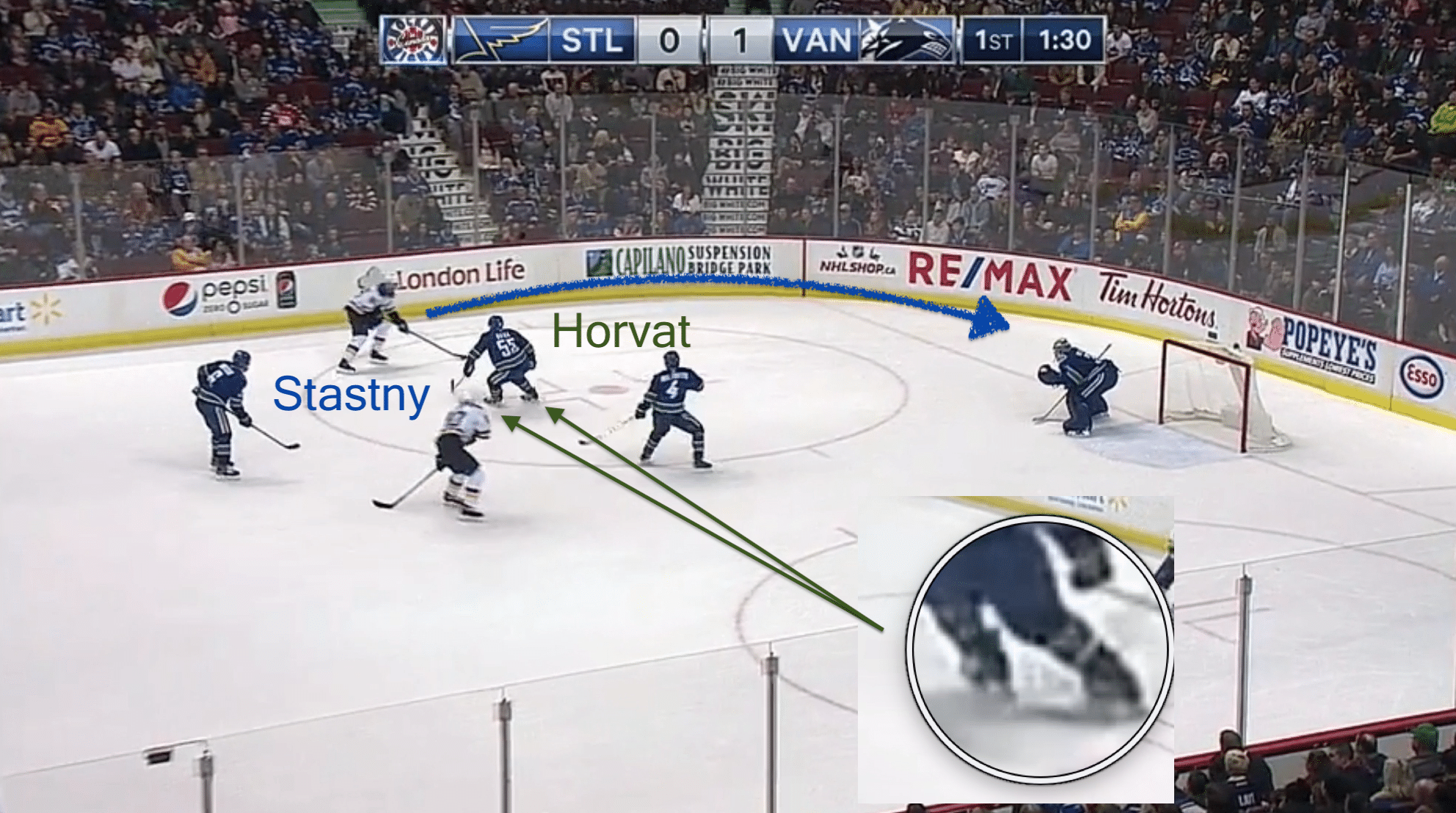
While Bo Horvat comes across and catches up with Stastny, Horvat is not in a good defensive stance. Because he came from the other side of the ice, Horvat's skates are sideways. He's not in a position on his edges to keep up with Stastny, who identifies this and takes Horvat wide, carrying the puck below the goal line.
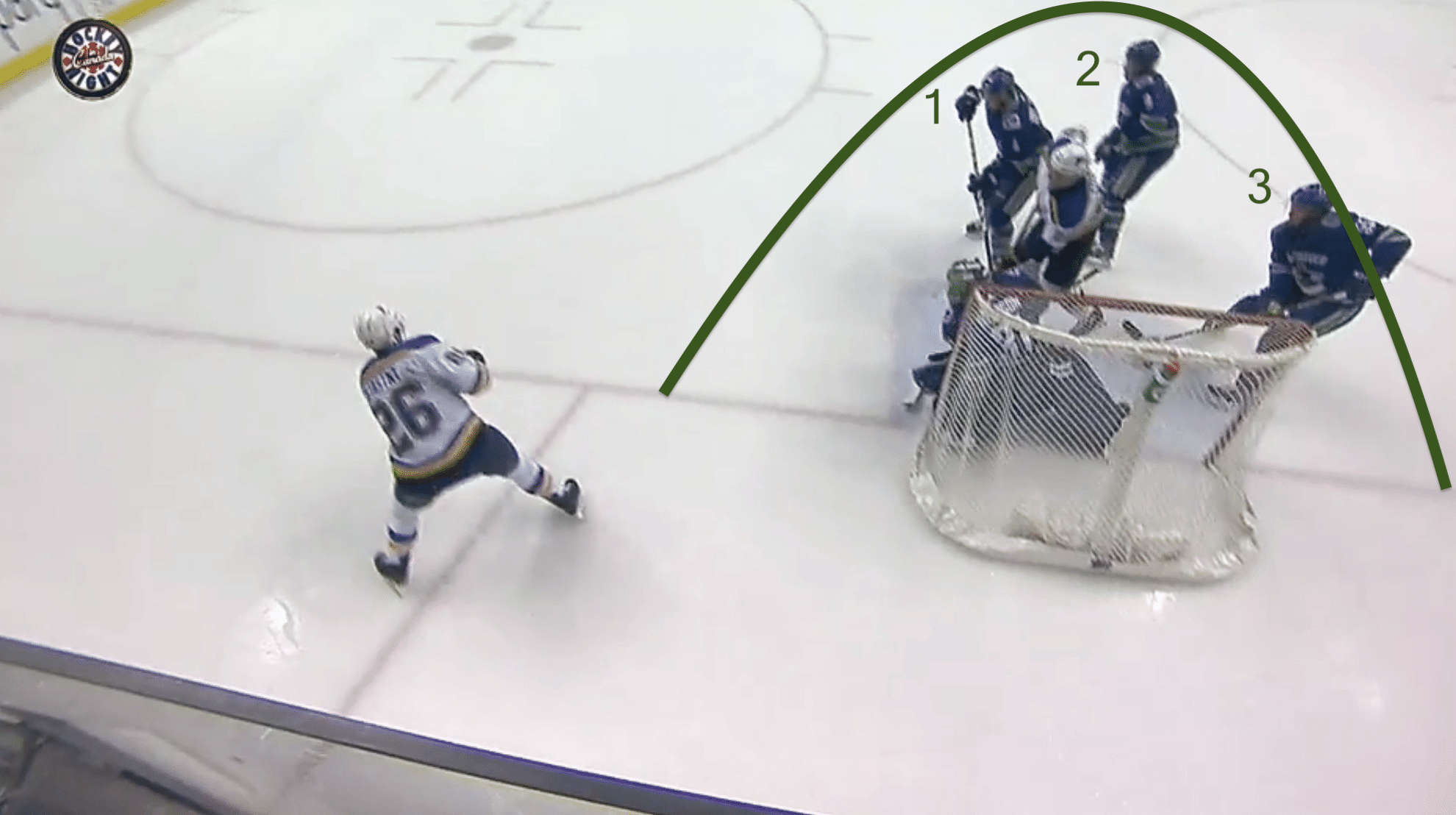
And this decision to circle below the goal has a byproduct. When Stastny cuts out at the other post, three Canucks are bunched in and around the crease (also in part because Steen crashed the net, a good play by him). Stastny has his head up the entire way and identifies Parayko coming down from the point, laying a perfect, flat pass for the defenseman to skate into.
Wednesday, November 1, 2017
Defensemen Joining the Rush
Friday, October 27, 2017
Marist Video
Team,
Did some breakdown of our game vs. Marist last week. Lots of teachable moments.
9:30 - Goal. Really nice exchange by Haraldsen and Doyle at the Blue Line to gain entry. That's an example of identifying options before blindly dumping the puck in. Harry then does a great job of recovering Haraldsen's net front pass and working the play back to the point. Doyle puts the puck on net and we recover the rebound to the left of the goalie on the half-wall. This is the type of offensive zone possession that leads to goals. Direct Goal Sequence - Haraldsen and Doyle do an extremely well executed exchange at the point and Doyle recognizes the open ice on the left side of the O-zone. He pinches in anticipating a rebound and is able to tap the puck into an open net when our point man fires a nice low POP (pass off pad).
11:15 - Goal. Here our 4th line capitalizes on a goalie mistake by winning a face-off and getting pucks to the net. Exactly the type of contribution we need from the 4th line. Pucks to the net and force the other team to make a mistake. I like how Pat O'Connell skates through the face-off off the draw. This pulls both his winger and d-man away from the net.
12:24 - This is an opportunity for JM to get his feet moving a second early and predict the play. Haraldsen did not make a perfect pass here but the idea was right. We want to move turnovers up ice as quickly as possible to initiate the counter-attack.
12:45 - Really nice D to D pass by Haraldsen to McFarland. Chris need to get his feet moving here and move up the ice. The defender takes a bad angle and has a lazy stick and would easily be beat or chipped off the wall to the left. Instead, Chris moves back into traffic and it results in a turnover. Good opportunity to read the play and take advantage up ice there.
13:00 - Ryan skates up ice and pulls off a shot through a screen. We need more of this.
13:18 - Sam has the right idea here. We want to move the puck up quickly, but that pass absolutely has to be on the tape. Instead of an offensive chance we end up with an icing. Small details.
15:43 - Great job by Sam to initiate contact and win a battle down low. That puck HAS to get out though. if you cant get enough leverage on a clear then eat the puck into the boards. This set up an opportunity at the point that better teams will capitalize on.
16:38 - Great patience by Finn here with the puck. He is prepared for the contact and waits for the right moment to clear the puck on the P.K.
21:27 - Outstanding job by Bertucci on the draw to swing through and help. This is exactly what we want our wingers doing. Was the point an option? If open, that is the preferred next move for Bertucci there.
21:50 - There is lots to breakdown on this 2v1. For one, Tom needs to take that space that the defender gives him to the middle. He is hurting his own angle by staying to the outside. If you are not in tight, that shot is simply not beating any goaltenders at the high school level. Number two, we need to be deceptive there and at least look at the pass to throw the goalie off. Number three, that shot really should be low blocker side. If you miss off the pad, we will have a nice rebound. Here is an example of great deception use on the 2v1:
23:08 - Awareness, awareness, awareness. Both Finn and Herber misplayed this O zone coverage. Pause the video at 23:14. Finn's feet are pointed the wrong direction (feet should have been pointed towards the puck and play). Herber is pinching on a puck that he will not get more than 60% of the time. Way too casual there Sean. If we give breakaways to Marist you better believe Loyola/Providence/New Trier are going to get them.
24:50 - Goal. Love how Sam clearly calls for the puck here. Gotta vocalize and let your teammates know. Great job stepping into the play and skating into a scoring area.
27:20 - Need less of a blowup attempt here by Finn and more of a closeout. Stick was not being used and check was missed. Again, the best forwards in this league will make you pay for this kind of a lunge.
That's all for now. 2nd half of game coming later.
-Coach Spence
Wednesday, October 18, 2017
Protecting the Puck
Boys,
I wanted to discuss puck protection as it is a crucial skill that will allow us to win the puck possession battle in games and create longer offensive zone shifts. It is important when you are working in tight spaces not to over handle the puck. Using your legs, skates, stick, and hands to shield the defender are all effective ways of maintaining possession. Watch Crosby in the following youtube compilation:
Link
- Crosby is incredibly effective at keeping his body positioned between the puck and the defender.
- When Crosby does makes a move facing his defender, the puck is in close to his body/feet.
- Crosby is always moving his feet and uses the cut back to tire out his defender and create space. (note: when Crosby cuts back, the puck is always facing the boards ie: protected)
- When Crosby fore-checks he does not blow guys up. His primary concern is taking away the defenders stick. He does this using the stick life, body positioning, timing, and hunger. Rarely do you see Crosby take a penalty in the offensive zone.
- When retrieving the puck, Crosby uses many shoulder fakes and then turns the other way hard. This is an effective way to get the defenders feet moving the wrong way.
- I love how Crosby braces for impact by placing himself square against the boards. This ensures that he will not get blown up and can maintain balance. He also leans into defenders to initiate the contact (Doyle has learned to do this when battling for a puck) See 5:38. 6:03.
- Last thing! He just stays so low. One of the keys to superior balance is to load up your power in your legs and stay low to the ice. The more your knees are bent and your butt is low, the harder it will be to push you off the puck.
Thursday, October 5, 2017
Mcdavid Magic
Love this goal last night from Mcdavid. Note how he pushes the puck in front of him and does not try to over handle. All he is thinking is speed. He turns a puck battle on the boards behind the EDM net into a semi breakaway. Ridiculous speed but a good example of putting the puck into space and focusing on skating.
Link
Monday, April 3, 2017
The Difference
I pulled this segment from an Alex Burrows Players Tribune article. I love the thought process and understanding of what teammates value.
Like, what is it called, you know — an out-of-body experience? Yeah, I was having one of those: Just standing there, off to the side … watching myself become an NHL player for the first time.
The game that night, given where my head was at, probably went about how you’d expect. I think we lost 4–1 (and it wasn’t even that close). But then late in the third period — when the game had already been out of hand for a while — something happened that I’ll never forget.
There was a scrum by our net, and I caught a little shove from Dennis Wideman.
And for a second there … I froze.
I think that shove from Dennis just kind of, I don’t know, maybe knocked the jitters out of me. And it got me thinking. Suddenly, in this split second, all of these thoughts were running through my head. Like: Alex — they’re going to send you right back down. You’re skating around doing nothing … the team is losing … and now you’re getting pushed around? You’re going to be Alex Burrows, the guy who spends the rest of his life telling people about the ONE game he played in the NHL. Way to go, dude.
It was like I saw my entire career, my entire NHL life, flash before my eyes.

And so I just thought, you know, I need to show these guys that I can help them win. That I’m not some starstruck kid. That I have a passion for this game, and that I’m going to do whatever it takes to stick around.
I gave Wideman a hard shove back — and within a couple of seconds, the gloves were off, punches were flying. Now, don’t get me wrong: I got my ass kicked. But honestly, that wasn’t the point. (Do you ever notice how it’s always the guy who got his ass kicked who says, “That wasn’t the point”?)
But in all seriousness: The point, to me, wasn’t whether I won or lost the fight. It was that I showed the guys I wasn’t just some kid, going through the motions, happy to be there. I showed them that I wasn’t just a guy in a Canucks jersey.
I showed them that I was a Canuck — and that I would do everything I could to remain one.
Wednesday, February 22, 2017
Protecting Home Plate - Fish
Time: 1:05 in Video
Toronto Maple Leafs "Protect Home Plate"
This breakout happens when we have lost control of the puck in our defensive zone, or when our
typical breakouts fail. The basic idea of this defensive structure is to keep the puck and opposing
players away from Doherty. Too often we find ourselves scrambling to get a puck out, and we seem
to lose composure and hockey sense when this happens. By piling players inside the house, we cut
off all possible threats of cross-crease passes which could easily be tapped in for goals. In diagram
A, it's clear that the crease and slot are covered by Ignatius players, and the only potential threats
would be coming from outside shots. In diagram B, which we tend to resort to while playing panic
hockey, when our players are spread out it opens up multiple passing options which could lead to
scoring opportunities. The result of this "Protect Home Plate" breakout isn't necessarily to carry the
puck through the neutral zone and set up offensive zone pressure, but rather it is to clear the puck
out of our zone so that the players on the ice can change. Because this is a last resort play, it could
result in icing the puck, but a better result would be dumping the puck into the neutral zone, or
having one player skate it to the red line and dump it in before changing.
-Dom

Mind Control - Gilbert
I put together a couple quotes from the book "Mind Gym: An Athlete's Guide to Inner Success"
by Gary Mack and David Casstevens that I pretty much live by. The book is about how to deal
with the mental side of sports rather than the physical side. This book really helped me become
the athlete I am today and I believe every athlete should read this book. My sophomore year with
baseball, I was a mental mess. I always carried my bad at bats to the next at bat and it ruined
me. I let my mind ruin my play. This continued into my junior hockey season. Whenever I would
mess up or have a bad shift, I would go nuts. I would become chippy and get very bad penalties
that hurt the team. About half way through the season, my summer league baseball coach
recommended for me to read this book. This helped me change my whole game. I now study
the game just as much as I practice the game. The important lessons that this book has taught
me is too always keep my head up and never get rattled, or else bad things will continue to
happen. Also I learned to truly play 100% is to know your strengthens and weakness. Know
where to improve but also know what you can contribute to help the team. I picked to do this
more on a mental aspect, rather than the physical aspect of the game because I believe our team
lacks some of this knowledge. With such a young team, we need to know that the mind is an
important factor to success.
Gilbert
Quotes
- "You have to train your mind like you train your body."
- "The mind works most effectively when you’re telling it what to do rather than what not to do."
- "Confidence comes from knowing you are mentally and physically prepared."
- "Learn to view pressure as a challenge to meet rather than a threat of defeat."
- "Successful athletes are able to control their emotions and behavior."
- "Mentally tough athletes possess an inner strength. They often play their best when they’re feeling their worst. They don’t make excuses."
- "You can’t control your performance until you are in control of yourself. What you’re thinking.How you’re feeling. Most importantly, your physiology. Know your numbers and your early warning signs."
- "You can’t perform well if you’re afraid of embarrassing yourself."
- "It’s important to look at yourself and identify your gremlins. In sports, as in life, the first step to success is getting out of your own way."
- "Goals are dreams with time lines. Turn your vision into action with goal setting. Seek progress rather than perfection."
- "Learn how to fail successfully. Hate to fail but never fear it. Learn to view failure as feedback."
- "While a positive attitude doesn’t always work, a negative attitude almost always does."
- "It doesn’t take talent to hustle and work hard. Invest in yourself with a positive attitude and “can-do” thinking."
- "At times we all get nervous and anxious. Learn to get comfortable with being uncomfortable."
- "Use your breathing to focus your energy. Let your breath center your mind and body in the present."
- "If your mind starts to wander so will your performance. Keep your eyes centered on the target and your mind set on the task at hand. Focus on the process and let go of the outcome."
Tuesday, February 21, 2017
Heavy Forecheck = Scrappy Goals - J. Madura
In this San Jose Detroit game, the Wings fail to break the puck out of the zone because the sharks are tenacious on the puck and extremely physical. By not allowing a clean breakout, the Sharks are able to sustain an offensive possession that eventually leads to a quality scoring chance. I think this is the type of aggressiveness we need in the offensive zone without the puck. Always need numerous bodies on the puck with the third guy high waiting to capitalize. A tenacious attitude in the o-zone is what leads to scrappy goals (the best kind).
John M
1v1 Defense - Schmitt
This video is worthwhile because
it outlines the basics of hockey 1 on 1 defense. In our last game we had
countless 1 on 1 breakaways. This video gives examples of gap control
and positioning in a 1 on 1 situation.
Evan
Pucks to the Net - Nick D'Andrea
Since the beginning of the season
our team has been excellent at cycling the puck and maintaining control once we
get it in their zone. However, we simply don’t get enough shots on net. I think
this goes for just about everyone on the team. Edler shows in this clip that
all you have to do is throw the puck to the net. We have heard this all year
from coach Smith, but we have never had a better example. I think as a team, it
is important that we learn to be less focused on getting the perfect shot on
net and more focused on getting the puck off as quickly as we can. It is also
important to mention that Edler lacks space in this situation. He has a player
coming from his right, and a player directly in front of him. Edler does have a
teammate in front of him ready to put on the jets if Edler decides to dump it,
but it is still a disadvantageous situation to be in. Regardless, Edler
recognizes what he sees and makes the best possible play. This brings me to yet
another crucial lesson to learn from this play. As important as it is to make a
play as quickly as you possible can, it is also important to take the time that
is given to you to make the best possible play. This just means keeping a level
head when you have the puck. If you’re able to keep calm when you’re in
possession of the puck, you will be able to make the best play possible in a
timely fashion.
Even though the scenario is a
bit different, this is another example of this type of play
Us vs. SI Cleveland. :17 second mark.
Nick
Elevating the Standard - Captain Jack
I selected this video because I believe that this is a video
we need to see this week with our state game coming up. At Ignatius we take
great pride in our academics and our athletics is overlooked. For some reason,
there is a nature at Ignatius where it is ok to be in second on the field as
long as you are first in the classroom. I am sick of this environment. I am a
two sport athlete and in my four years at Ignatius I have two playoff wins to
show for. Two. One of them was CCHL too, yet everyone within the Ignatius
environment still pats you on the back for putting forth a good effort. That is
bullish*t (excuse my language). I am sick and tired of settling for second. I
have seen the hockey program go through one heck of a roller coaster in my four
years, but never have I been apart of a team with as much opportunity as we
have and we have earned it all by working our tails off every day. This team has
more hunger than any other team I have been on. If you had told me that we
would regularly be starting practices at 3:35 four years ago when it was ok to
get on the ice at 3:52, I would have laughed, but that shows the character and
hunger this team has. I don't want to be remembered as the team who had
potential. I want to be remembered as the team who took Ignatius hockey to the
next level. This year has been an amazing year, but its not even close to over.
At the beginning of the season we joked about playing at the UC on March 17,
but now it is out there for the taking and I am hungry for it and I know my
brothers are too. Five. Five games until we do something that no one would have
ever imagined. No one believes in us except ourselves. Now lets go out and
prove everyone wrong. I want to be remembered as the team who won state as a
team, not individuals. As my good friends Lilo and Stitch once said,
"Ohana means family, and family means nobody gets left behind." We
win State together as a brotherhood, as a family.
J.C.
Depth and Team Contributions - Myers
So
for my assignment I choose to read an article on the hockey news website. It's
about the Minnesota Wild and how their biggest key to success is their depth.
The article talks about how Minnesota's success is because of their ability to
get offense from all of their players. Sure, they have one of the best coaches
in the league and Dubynk has been on his game for the majority of the season, but they have been playing as a team and they've been getting offense from
everyone. What our team can take away from this is that we all need to make
sure we find a way to contribute during our state run. Everyone has to be
making plays to contribute to our success. Get the puck to the net or grind it
in the corners whatever we gotta do to win. By getting offense from all our
guys we are gonna be tough to stop. No one predicted the Wild to be one of the
top teams, but they've found themselves in a good position to make a run for
the cup, because of their depth. We must do the same, we need to rest up and
focus on practice this week so that we are all ready to make an impact on the
game this Friday.
Ryan M.

Catching and Controlling Passes - McMann
One part of our team's game that I think we are lacking in
is the accuracy of our passes along with our ability to catch passes that are
inaccurate or put in hard places to catch. Throughout the whole game Friday
against Benet, they would make long cross ice passes right on the tape, which
were the cause of the numerous odd man rushes they had. That is why they played
so much better in the neutral zone than we did. It is also why we struggle
sometimes breaking out and keeping control of the puck. Our goal right now is
to get the puck in the vicinity of the man we are passing too when in actuality
we should be aiming for their stick. Although we have worked on it briefly in
practice, I believe that we should work on stopping pucks with are skates or
being more flexible with our stick. Attached is a video Sydney Crosby showing off
his ability to catch passes that are inaccurate.
McMann
Face-Off Urgency and Set Plays - Rotunno
Link
In the video, right off the face-off the winger comes off the boards hard to the puck while the
center ties up the other center. The winger goes right off the face-off to win the puck
meanwhile Zuccarello moves in front of the net and gets open enough to open up a pass
from the other winger. When the winger with the puck centers the puck to in front of the net
Zuccarello uses his foot to kick the puck to his stick to quickly release the puck on net for a
game winning goal. We have been stressing the whole year about applying pressure on the
other team right off the face off. Now that I'm a winger I have been more focused on being more
aggressive on the puck, taking quicker shots, and using any means necessary (using feet to
kick puck to stick) to get shots or passes off just like the clip shows all three. Not only me but all
the offense can use this video to help guide them to what to do in offensive zone face-offs.
Evan
Creating Room in Tight Spaces - Wallace
The reason why I like this move is because it is a perfect way to
create space in a tight area. In all of these scenarios Datsyuk has a defender
putting close pressure on, so a quick change in direction gives him more time
to make a play. We work on this in practice all the time but the key is that
his head is always up so that he can anticipate the situation and execute the
move when the defender comes too close. He also keeps the puck close to his
body to avoid the poke check and have the opportunity to make multiple cuts.
This move is extremely efficient in the offensive zone because it can be used
with relatively little space and almost always achieves its goal by giving the
player more options.
J.M.
Importance of Good Breakout Passes and Low, Hard Shots - Finn
In the Hawk’s game against the Sabres, for the Sabres only
goal, Toews got a bad breakout pass and then couldn’t get the puck past the
defender pinching. I feel like this happens a lot in our games and whenever we
can’t get the puck out of the zone the other team will get a lot more chances.
For Hossa’s goal, it’s a great example of just getting shots on net. He takes
the one timer and then the hawks recover the rebound and Hossa gets it back and
finds a lane and just gets it low and on net. I feel like we don’t get enough
low hard shots on net. The hawks next goal is similar in that Panik just fires
it on net hard off the one timer and toews buries the rebound.
The hawks next
goal was a really pretty tic tac toe. Kane knows exactly what he was going to
do with the puck before it even got there. This is similar to the glory road
drill that we do in practice.
In regards to the Benet game, I feel that we struggled a lot
with putting rebounds in the back of their net and also keeping rebounds out of
our own net. I think a majority of their goals were rebounds in front of the
net and also we could have put at least two or three of our own rebounds in
their net.
Finn
Preparedness, Focus, and Work Ethic - Doyle
In this video from the NTDP it talks about how if you want to be successful, all of these other things must be at full strength. First is preparedness, I believe that as a team, if we show up to think rink prepared to either practice, or play a game, that we will have a strong effort. When we show up to the rink ready to play, there is no one in the state that we can’t beat. On the other hand, if we aren’t prepared on that day, we can get our asses handed to us by just about anyone. The second thing is focus. If we put everything in our lives that isn’t absolutely necessary, then we will be prepared and focused. Especially at this time of year, we must put stuff such as parties, girl, and other social distractions out of our thoughts and give our entire focus to getting what we need to get done at school, so that we can be ready to go at the rink. The last thing is our team work ethic. This work ethic is mainly at practice. At this time of year we can’t afford to have any blow off days at practice and sure as hell have to have our best foot forward on game day. These are all mental things that if we work on and put all together, we will be unstoppable during state.
Patrick
Editors Note - This speech in its entirety is awesome. I listen to it when i need a reminder.
Capitalizing on Turnovers, Getting Pucks to the Net - Mathurin
The video I selected was from the Redwings vs. Penguins
on Sunday. Watching the highlights, I see pucks being moved to the net, which
was a reason for 5 goals throughout the game for the Wings. Something we need
to do better as a team is move pucks to the net for better scoring
opportunities. We also need to work on getting the puck deep. This will make
the defense work harder every time we dump the puck in, leading them to be more
tired. Another point that I saw in the video was the turnovers in all three
zones, the Redwings capitalized on two turnovers, one in the neutral zone and
one in the defensive zone. As a team, puck possession is key, we must hold the
puck and make good passes to open ice for more goals in the post season. We
must also not be afraid to go to the dirty areas on the ice and win puck
battles. This all leads to teach success.
Marcus
Drawing Players in to Create Space - Gaudet
Link

I have chosen the final play in this countdown for this
assignment. Even though it's a really basic maneuver it shows how we should
always have an idea for what we should do with the puck before we even receive
it. This player recognized that the back door was completely open and caused
the defenseman to over commit to him. This leaves his teammate wide open on
the back side of the net giving him a chance to get an easy goal. This isn't
the only spot were we need to be one step ahead of the game, but rather for
wingers on breakouts, battles on the boards, passes in the neutral zone, etc.
it shows how you have to be mentally there in the game not just physically. By
having an idea with that you want to do with the puck before you even have it,
you set up plans for what you should do. This a strategy that's defensive and
offensive since you have a plan in your back pocket. I can't stress on how
important it is to wait to pass until you force your opponent to over commit to
you. That's when their defensive structure break down and your team can create
a play. We need to get use to drawing players out more on power plays to create
a defensive breakdown that can lead to us scoring a power play goal.
Grant

Monday, February 20, 2017
Puck movement/anticipation - Chris Mcfarland
I
thought this goal was a great example of good puck movement, and knowing where
you are going to put the puck before you get it. This is something that I think
I need to work on defensively and offensively especially at the point and
coming around the net in the D zone. Also for the team I think this is a good
example of our power play unit two because the Avalanche really used the
umbrella to it's full potential here, by moving the puck quickly and getting it
to the net for a scoring opportunity.
Powerplay Urgency - Skinny
In
this video, the Islanders are on the power play and need to score in order to
secure a two goal lead. The puck starts in the islander's defensive zone. They
seem to effortlessly break the puck out by simply looking for an open man and
keeping the pace fast in the defensive zone. As soon as they enter the
offensive zone, they are able to score. Tavares is left wide open just to the
right of the slot and releases a quick shot on the goalie. We can learn from
this because it shows how it is important to break the puck out quickly on the
power play to catch the pk on their heels and to release a quick shot to try
and catch the goalie off guard. - Skinny

NHL Breakouts from Defensive Zone Play - Sam
(Flames
Breakout 2:21)
The flames breakout the puck with one wing posted
at the hash and two forwards swinging near the middle to support him. The wing
at the hash with the puck was stagnant, although, he was able to break it out
because the strong side defenseman pinched and had poor positioning on him. If
the D were to be conservative and hold back, he could easily close off the
passing lanes to middle at an angle and trap the wing because he has no
momentum. I think it is imperative that our team understands that having a
motionless strong side wing at the hash will only be successful in certain
situations. There has to be a clear, moving outlet. This is less common at our
skill level than at a professional level. This is why I am very supportive of
the breakout that Coach Nick showed us last practice: the wing on the hash and
the center switch almost like a scissor play so that the center is swinging up
the boards along the hash and the strong side wing is swinging up ice towards
the middle. This ensures that all pieces are moving and can also catch the
defenseman off guard.
Sam Madura
Tuesday, February 14, 2017
Beanpot
For those that don't know, the Beanpot is an awesome tournament to decide who is the best team in Boston each year. It's played at the T.D. Garden between Northeastern, BU, BC, and Harvard and has been taking place since the 50's.
1. 1-0 Harvard - This first goal has a few lessons. First of all, its a 5v3 so there is a ton of space out there. This makes it crucial to get the puck over "glory road". I like how the D are moving their feet and making crisp passes to create that opportunity. Then there is the play through the whistle persistence by their forward. We are going to need a goal like that in the state tournament.. Never quit on a puck until you here that whistle.
2. 1-1 Tie - Great puck movement here by BU. They use the Umbrella Power Play formation which looks like this:
 The idea is to have outside shots fired while player 5 and 4 converge on the net for rebounds. Nice job by player 2 to get a hard low shot pass onto the stick of player 5. This is a good example of just getting the puck on net by that player. He redirects the puck towards the net and they capitalize on the scramble. One of the takeaways here is the urgency to get the puck on net.
3. 2-1 BU - Can't stress this enough: D who get pucks to the net quickly stack up points. Clearly this was an elite deflection but it is created from the D-mans urgency to get he puck off his stick. I also liked Greenway's entry into the zone. He gets a pass with very little space and puts the puck to an area where he can recover it.
4. 2-2 Tie - Theme has been consistent in this game. The D are very active in scoring at the high levels of hockey. Really like the D's shot placement here. He has his head up and finds the lane where the puck will not be blocked. Often, the puck doesn't have a direct path to the net. D should be looking to shoot through lanes that insure the shot doesn't get blocked and the play can continue in the offensive zone.
5. 3-2 Harvard - Awesome job here gaining the zone off of a neutral zone by the Crimson D. No delay in pushing the pace up the ice. We see a lot of this from J.C. Turnovers converted into sustained offensive pressure. Chaos goal but the turnover and quick zone entry were key.
6. 4-2 Harvard - Harvard uses the box and 1 powerplay here:
 Honestly, this is classic glory road. Moving the puck quickly to create opportunities. Forward "2" lured the defense out of position which set up the point blank opportunity. Like the persistence by player 3 at the net as well.
7. 5-2 Harvard - Beauty goal which started again with a neutral zone turnover. Love the wide drive with speed and the cut back but this goal is really on the Terriers defensman #8. He completely quits on the play after he is beaten to the outside.
8. 5-3 Harvard - Keller was ready to pounce on this goal. I really like the mentality and game awareness he shows here. BU is down 3 goals with 7 minutes left. In a situation like that, you have to take chances that you would not normally take. He pinches immediatley and gets a nice low hard shot off to bring the game within 2.
Best in the NHL at shooting the puck quickly and through screens:
1. 1-0 Harvard - This first goal has a few lessons. First of all, its a 5v3 so there is a ton of space out there. This makes it crucial to get the puck over "glory road". I like how the D are moving their feet and making crisp passes to create that opportunity. Then there is the play through the whistle persistence by their forward. We are going to need a goal like that in the state tournament.. Never quit on a puck until you here that whistle.
2. 1-1 Tie - Great puck movement here by BU. They use the Umbrella Power Play formation which looks like this:

3. 2-1 BU - Can't stress this enough: D who get pucks to the net quickly stack up points. Clearly this was an elite deflection but it is created from the D-mans urgency to get he puck off his stick. I also liked Greenway's entry into the zone. He gets a pass with very little space and puts the puck to an area where he can recover it.
4. 2-2 Tie - Theme has been consistent in this game. The D are very active in scoring at the high levels of hockey. Really like the D's shot placement here. He has his head up and finds the lane where the puck will not be blocked. Often, the puck doesn't have a direct path to the net. D should be looking to shoot through lanes that insure the shot doesn't get blocked and the play can continue in the offensive zone.
5. 3-2 Harvard - Awesome job here gaining the zone off of a neutral zone by the Crimson D. No delay in pushing the pace up the ice. We see a lot of this from J.C. Turnovers converted into sustained offensive pressure. Chaos goal but the turnover and quick zone entry were key.
6. 4-2 Harvard - Harvard uses the box and 1 powerplay here:
7. 5-2 Harvard - Beauty goal which started again with a neutral zone turnover. Love the wide drive with speed and the cut back but this goal is really on the Terriers defensman #8. He completely quits on the play after he is beaten to the outside.
8. 5-3 Harvard - Keller was ready to pounce on this goal. I really like the mentality and game awareness he shows here. BU is down 3 goals with 7 minutes left. In a situation like that, you have to take chances that you would not normally take. He pinches immediatley and gets a nice low hard shot off to bring the game within 2.
Best in the NHL at shooting the puck quickly and through screens:
Monday, February 13, 2017

Friday, February 10, 2017
Faceoff Help. Small Details. Winning Series.
Talk about the little things winning a series. I was looking for a clip to torture my buddy who works for the Capitals. Then bingo:
Look at the help from the winger to win that puck to the side wall. I love how ready the Rags were to pounce on this opportunity. Girardi shifted to the top of the key and crushed a low hard shot on goal. Next thing you know series was over. We need to be deliberate and ruthless with our opportunities. It's the only way we will beat the top talent.
Glory Road!!! No Delay! Series over!
Jumping into the play, tracking, and the pad pass. All in one. Little things done right...
Wednesday, February 8, 2017
Self Reflection
Times Article
I wanted to share the article on Russell Westbrook that appeared in this Sunday's New York Times Magazine. The quote I read from Coach Billy Donovan is below. Ask yourself the same questions: How hard are you competing? Are you bringing the energy, the passion, the fire to win loose pucks? Make a decision not to live with any regret about this season. The Catholic League playoffs are behind us. Can't go back in time. Need to bring all experiences (Loyola tournament at Thanksgiving, win against Providence, Jesuit Cup, CCHL playoffs, etc.) to bear during the state tournament. - Coach Smith

I wanted to share the article on Russell Westbrook that appeared in this Sunday's New York Times Magazine. The quote I read from Coach Billy Donovan is below. Ask yourself the same questions: How hard are you competing? Are you bringing the energy, the passion, the fire to win loose pucks? Make a decision not to live with any regret about this season. The Catholic League playoffs are behind us. Can't go back in time. Need to bring all experiences (Loyola tournament at Thanksgiving, win against Providence, Jesuit Cup, CCHL playoffs, etc.) to bear during the state tournament. - Coach Smith
"The No. 1 thing for him is how hard he competes. It starts
there. That doesn’t mean he plays a perfect game, doesn’t mean that he never
turns the ball over, doesn’t mean that he doesn’t miss a defensive assignment.
But when the ball is loose on the glass or on the floor, when it requires
energy and passion and fire — Russell is bringing that. So many players live
with regret: They could have done a little bit more, been more committed,
worked harder. I think he’s going to have a great level of peace when his time
is done. He’s going to be able to move on with his life. He’s going to have
peace in his heart.”

Friday, February 3, 2017
Stretch Pass
Textbook stretch pass from Burns leading to Patrick Marleau's 500th NHL goal. SJ takes advantage of the powerplay by having a winger sneak to the weak side to create the odd-man. We need to perfect this.
Wednesday, January 25, 2017
Mikita article and Hawks highlights
Stan Mikita Article
Lets Start with the Toews goal. I love Hartman's ability to read their breakout. As the third man he is watching Hedman's eyes to see where he is going with the breakout. When Hedman turns it over he moves the puck quickly. Toews has his head up and knows where he's going before the puck gets to him. Before you know it, back of the net.
(1:41) On Boyle's goal, he finishes his check on Keith at the point and then gets his legs moving to split the D. Hjarmallsson and Keith are split too far apart and neither has the urgency in this situation to close the gap. Gilbert like goal from Boyle. Takes puck right to the net.
(4:00) This is just a classic exchange play. We want to see more of this, we need more of this. its a 2 on 3, but with a simple exchange they freeze the D and Johnson gets a great shot off. On the Defensive end, TVR needs to make a better read there.
For inspiration:

Subscribe to:
Posts (Atom)